
Co-Founder of XYO
Marcus Levin

Co-Founder of XYO

Share


the The next trillion-dollar infrastructure revolution It won’t start in Silicon Valley. Instead, it is expected to be held in Nairobi, Manilaor Medellin.
Developers focused on emerging markets are building networks that support real-world connectivity, power, and data access. The world is fascinated by artificial intelligence, robotics, and cryptocurrency adoption, but more attention must be paid to the networks that will be used to deploy these technologies for practical purposes that improve the lives of real people.
As these decentralized networks expand, they also create the foundation on which artificial intelligence and robots will rely to operate in the real world. Distributed, verified data from DePIN networks could guide autonomous systems in agriculture, manufacturing, and logistics, enabling robots and other smart devices to make informed decisions that directly improve daily life in developing regions.
In 2026, Decentralized Physical Infrastructure Networks (DePINs) They are entering a new phase. In recent years, the sector has achieved record levels of activity. And just in the last three months, DePIN tokens have appeared 75% monthly network feerising from $1.3 million in July to $2.3 million in September.
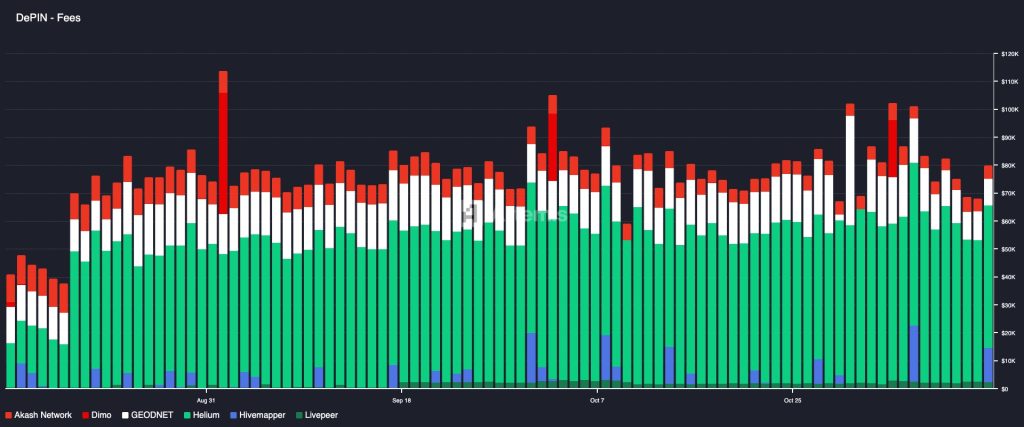
This recent growth is a clear sign that people are not only trading tokens, but also using them to access the services offered by DePINs. This combination of active trading and active utility is the optimal economics for the DePIN model, and watching promising projects come online is satisfying for DePIN investors, developers, and enthusiasts.
The most significant growth is emerging in areas that have long suffered from a lack of traditional infrastructure. There, decentralized networks are solving concrete problems, from enabling Internet access in rural areas to enabling unbanked citizens to earn income by sharing data.
In 2026, DePIN is It is destined to become a phenomenon.
Emerging markets are DePIN’s natural home
In the developed world, most critical infrastructure sectors are guarded by giant monopolies worth billions of dollars.
according to a16z 2024 State of Crypto Report, OpenAI and Anthropic have 88% of the original AI company’s revenue share, Amazon WAWS), Microsoft Azure and Google Cloud Platform (GCP) hold 63% of the global cloud infrastructure market share, and at the same time, NVIDIA has a 94% share of the data center GPU market. But what happens when one of these giants is in danger?
A clear example of how fragile these centralized systems are has recently emerged, when… AWS service outage On October 20 it broke down More than 6.5 million users And more than 1,000 global companies, including Snapchat, Amazon, Coinbase, Robinhood, Reddit, and Fortnite. The same pattern repeats across sectors: when one provider fails, entire economies falter.
Centralization generates efficiency, but it also generates weakness. The more forces are consolidated, the more fragile systems become, and the more difficult it is for innovation to emerge. For smaller startups or decentralized networks, entering these saturated markets means competing with trillion-dollar incumbents who control not only the infrastructure, but also regulation, pricing and access.
That’s why emerging markets have become a natural home for DePIN. In regions like Nigeria, the Philippines, or Colombia, it is possible for decentralized networks to grow without encountering the same massive gatekeepers.
Throughout Africa, for example, it is over 350 million adults remain “unbanked.”“- Lack of access to financial services from huge monopoly banks. However, Sub-Saharan Africa has emerged as the poorest region The third fastest growing crypto space in the worldhaving received more than $205 billion in on-chain value last year, an increase of 52% year over year. This highlights how this lack of access to services has pushed people towards more decentralized and participatory financial infrastructures.
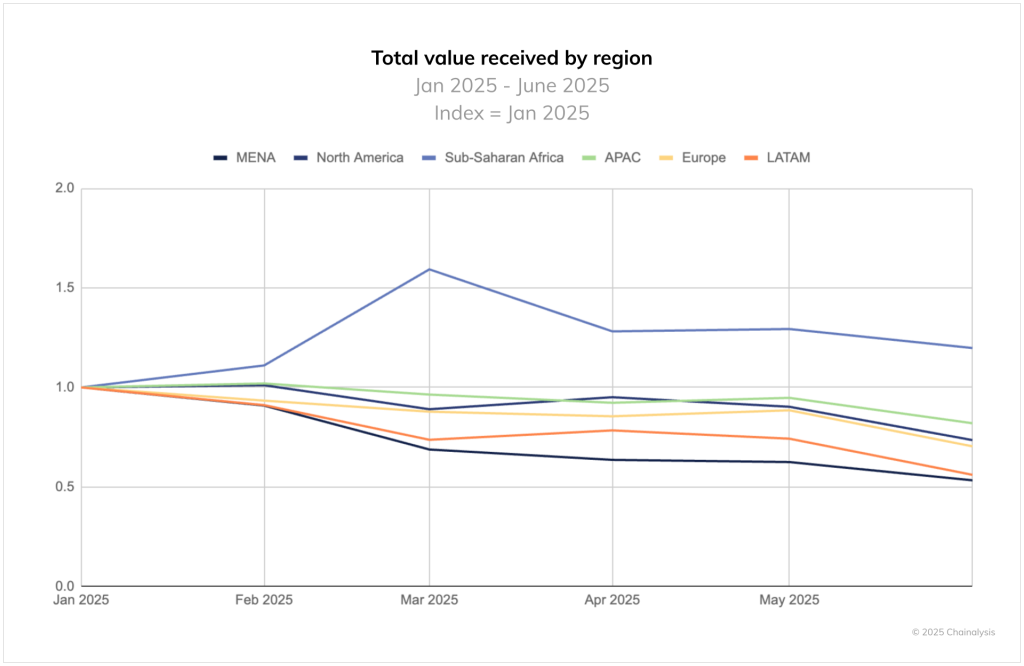
Similar patterns are also unfolding elsewhere. In Latin America, community-powered wireless networks are Providing affordable connectivity In areas where expansion of traditional communications is still not economically viable. Established technology companies are also taking notice of the value offered by the DePIN sector.
In 2024, Samsung Asset Management, SamsungNext, Invested in ROMDePIN builds decentralized mobile networks. Venture capital investment in DePIN It is growing rapidly, with more than $744 million invested by mid-2025 across more than 165 startups.
We’ve seen this pattern repeat itself across every major investment cycle. A group of people have a real problem and decide to build something new to fix it. In the beginning, the goal is not profit, but practicality. Technology suits them first, and that’s what gives it real benefit.
2026: The year DePIN went mainstream
Experts predict that by 2028, the DePIN space will be reached It could reach $3.5 trillionThe groundwork for this has been quietly laid over the past year. Regulatory clarity, technological maturity, and increased participation are now converging, paving the way for a global resurgence of DePIN.
The turning point came when… US Securities and Exchange Commission (SEC).) Corporate Finance Department Issue a no-action letter on DoubleZero token distributions, effectively recognizing that activity-based rewards in DePINs are different from securities. This is a sign that building and rewarding engagement in the real world is now a legitimate and recognized model. The decision has opened the door for DePIN projects that have long operated in a gray area to openly expand their scope.
This clarity has inspired movement beyond the borders of the United States. Abu Dhabi Digital Energy Infrastructure Fund worth $500 million DePIN supports blockchain-enabled projects that integrate renewable energy generation with distributed computing.
At the same time, new capital and new builders are entering the DePIN ecosystem. The venture funding that used to chase DeFi protocols is now flowing toward DePIN startups focused on computing, storage, and wireless connectivity. Recently, io.net announced that one of its clients It raised $20 million in a Series A funding roundWhile I was raised Launched a $100 million fund For artificial intelligence projects and games.
Much of this new momentum is related to the growing need for decentralized computing and data systems that support artificial intelligence and robotics. By distributing these resources through DePINs, developers are creating smarter, more secure networks that allow intelligent systems to learn and act on verified information. This shift is necessary as intelligence continues to move from centralized data centers into the physical world.
It’s no secret that DePIN’s momentum is no longer limited to cryptocurrency circles. Instead, they are gradually being integrated into broader conversations about energy resilience, digital inclusion, and artificial intelligence. As these worlds intersect, DePIN sheds its label as a niche experience and emerges as a blueprint for the next phase of the digital economy.
In 2026, this shift will become impossible to ignore. As artificial intelligence, robotics, and technology become part of everyday infrastructure in every corner of the world, DePIN will serve as the connecting layer that gives these systems reliable data and the ability to interact with the physical world in meaningful ways.
Disclaimer: The views and opinions expressed in this article are those of the author and do not necessarily reflect the views of Cryptonews.com. This article is for informational purposes only and should not be construed as investment or financial advice.