
XR glasses and virtual idol concerts are converging, but when a head turn outpaces the display, immersion collapses. The infrastructure between XR content and devices remains a gap. Mawari is filling it.
-
Virtual IP industries leveraging XR have grown significantly. But even as AR/XR devices advance, the infrastructure connecting content to devices remains underdeveloped.
-
Over 8 years, Mawari built a system that streams 3D content at the object level, splits rendering between device and server, and executes on the nearest GPU node.
-
Node sales succeeded even without a token, proving that the infrastructure holds value on its own.
-
Rather than waiting for XR adoption, Mawari is building use cases now and betting on the market’s eventual expansion.
Virtual idols and VTubers have already gone mainstream. Since Gorillaz won a Grammy in 2006, virtual performers have steadily entered everyday culture. Live virtual broadcasts are now widely accepted.
Korea and Japan lead this market. Korea’s virtual K-pop idols draw large audiences, while Japan has built the world’s most mature virtual ecosystem around Hololive and Nijisanji. Meanwhile, XR devices, led by Meta’s smart glasses, are regaining attention and driving new demand for XR technology.
The problem is that the technology and infrastructure to support this demand are not yet sufficient. Natural-looking virtual idol performances and seamless AR guidance through smart glasses both require real-time 3D rendering: every frame must be redrawn and delivered in sync with user movement.
Even a 0.1-second delay is unacceptable.
Mawari recognized this problem early and has spent eight years solving it. The company’s answer consists of two technologies.
-
Engine: Streams interactive high-quality 3D content and offloads heavy rendering from the device to external GPUs.
-
Network: Distributed GPU nodes near users execute rendering on their behalf.
The model works like an optimized delivery system. Heavy sorting is handled in advance at a central warehouse, and final delivery is dispatched from a nearby hub. The more efficient the warehouse, and the closer the hub, the faster the delivery.
Just as same-day delivery requires the warehouse and local hub to work in sync, real-time 3D experiences become possible only when the engine and network layers operate as a single integrated pipeline.
The core streaming technology is called Mawari Engine. Conventional approaches stream full 3d scene as virtual camera view. Mawari takes a different path: it does object streaming and uses a split rendering approach.
Consider watching a virtual idol concert through AR glasses. The old method required resending the full frame of the entire scene, including stage, lighting, and character, every time the idol moved. It is like a video call retransmitting the full frame when only a hand moves.
Mawari’s Object Streaming works differently. The idol character is the only object needed to stream. The device assembles the scene locally. Since it is an AR experience the real world is the actual scene. Lighting is fully processed on the server side. When the idol raises an arm, only the changed motion data is sent. Lighting is applied on the object during the process on the server side.
When the user turns their head, the device recalculates the viewpoint from the objects it already holds, with no need to request anything from the server again.
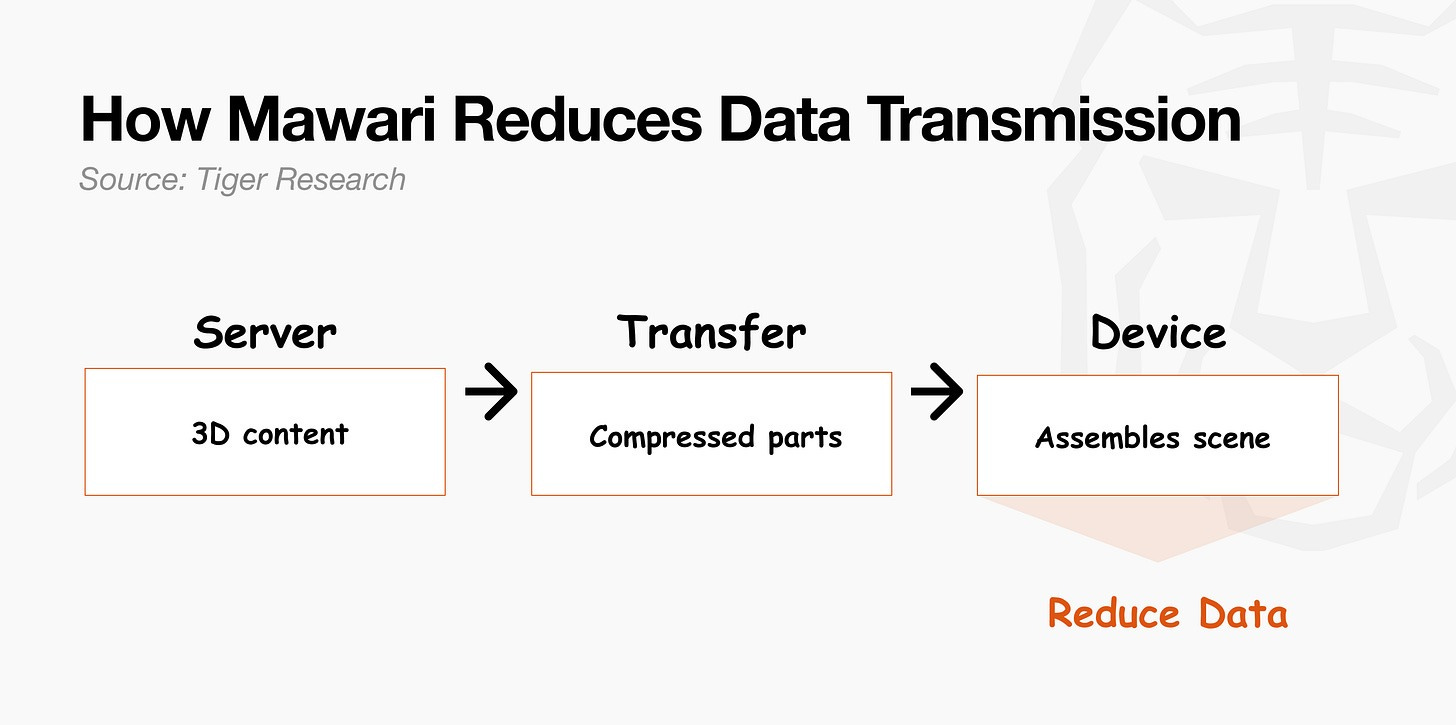
On top of this, the engine’s internal codec dynamically compresses objects based on connection quality. On a strong network, it transmits at high fidelity. On an unstable connection, it increases compression. This ensures stable quality at minimal bandwidth in any environment.
Because overall transmission volume drops, bandwidth usage is reduced by approximately 80%.
Even with efficient object transmission, someone still has to render that 3D content. The question is where.
XR devices are evolving toward lighter form factors. As they approach the shape of ordinary glasses, like Meta’s smart glasses, onboard chip performance hits a ceiling. Pushing high-quality real-time 3D onto the device alone creates heat, battery, and weight problems.
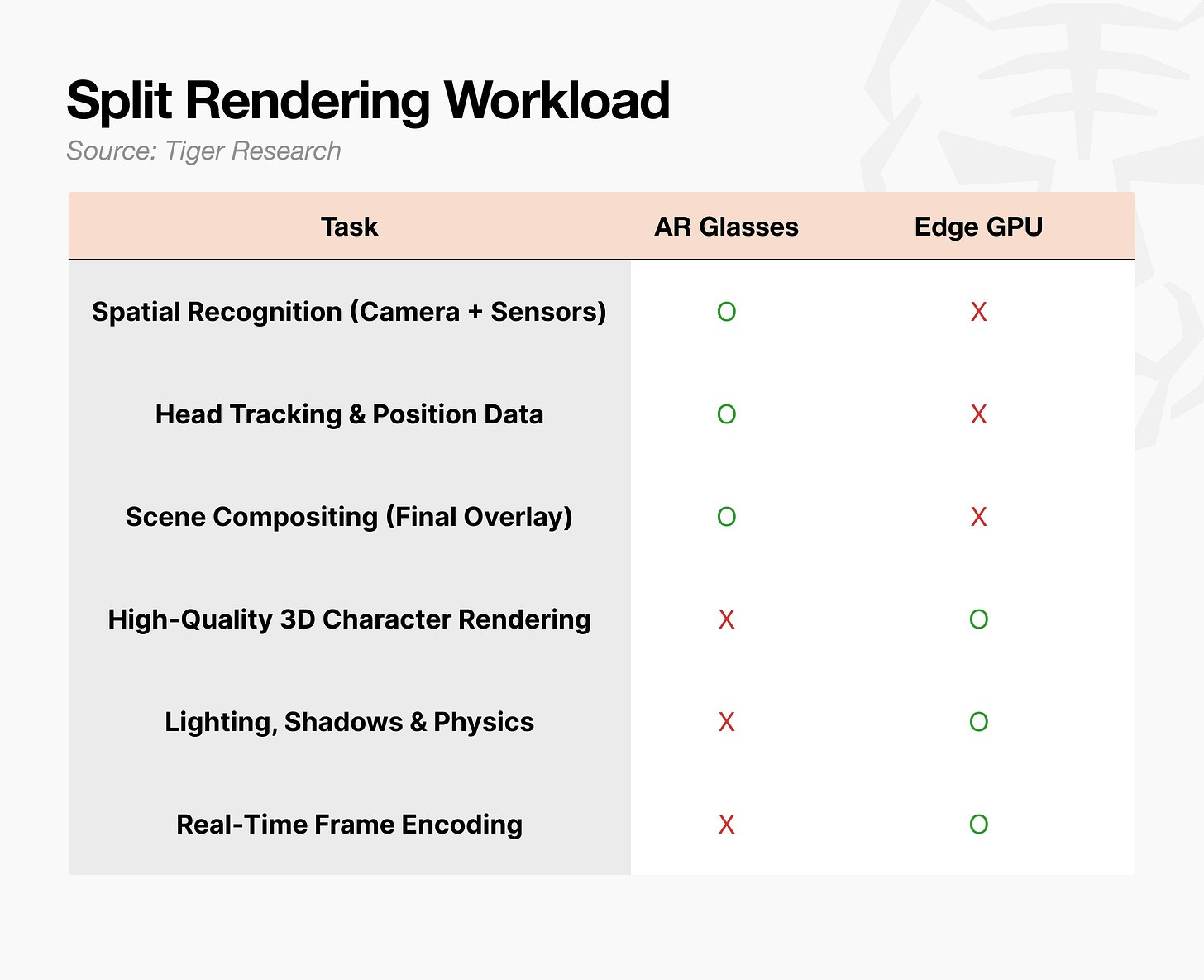
Mawari’s engine solves this not by boosting device performance, but by splitting the rendering workload.
This is Split Rendering. The engine automatically determines the split based on content complexity. AR-specific and high-frequency tasks such as spatial recognition, head tracking, and final scene compositing stay on the device. Heavy tasks such as high-quality 3D character rendering, lighting and shadow computation, and real-time frame encoding run on edge GPUs.
The two outputs merge into a single user experience.
Even if the engine transmits objects efficiently and splits the rendering workload, none of it matters if the GPU is far from the user. Just as deliveries arrive faster from a nearby hub, GPUs must be physically close to users.
In XR, the time from a head turn to the corresponding frame reaching the user’s eyes must stay under 20ms. This is the threshold at which humans start getting discomfort and cybersickness. Anything slower causes a mismatch between display and body movement, producing dizziness and breaking immersion.
The problem is that existing large-scale cloud infrastructure struggles to guarantee this threshold globally. AWS and Google Cloud offer cloud rendering environments, but their data centers are concentrated in limited regions. Consistently maintaining sub-20ms latency for every user worldwide is difficult. The farther a user is from a data center, the wider the gap.
The solution is closing the distance. When GPUs sit in the same city or region, round-trip time drops and staying within 20ms becomes far more achievable.
This is why Mawari is building a globally distributed GPU node network, positioning compute resources near users rather than relying on a few centralized mega data centers.
Users do not connect to multiple nodes simultaneously. Mawari’s engine automatically selects the single most suitable node based on distance and network conditions. The user connects to that one node for rendering.
The engine streams 3D content at the object level and splits rendering. The network places the GPUs that execute that rendering close to users. These two layers combine into a single pipeline.

No matter how efficient the engine is, speed ultimately depends on how densely GPU nodes are deployed.
In April 2025, Mawari announced its DIO (Decentralized Infrastructure Offering) to begin scaling the network. By the time public sales launched in July of the same year, roughly 140,000 of the total 300,000 nodes had already been reserved, with $45 million in committed participation.
However, since coverage scales in proportion to the number of participating nodes, true global coverage remains a work in progress. The challenge is deploying more nodes, faster.
Mawari’s approach has two tracks. The first is to specialize node roles, optimizing performance while lowering the barrier to entry. The second is to design economic incentives that sustain continuous growth in node count.
Network performance depends on node architecture. Most DePIN projects assign the same function to every node. Mawari takes a different approach, dividing node roles into four types: rendering, verification, monitoring, and testing, so each can focus on its designated function.
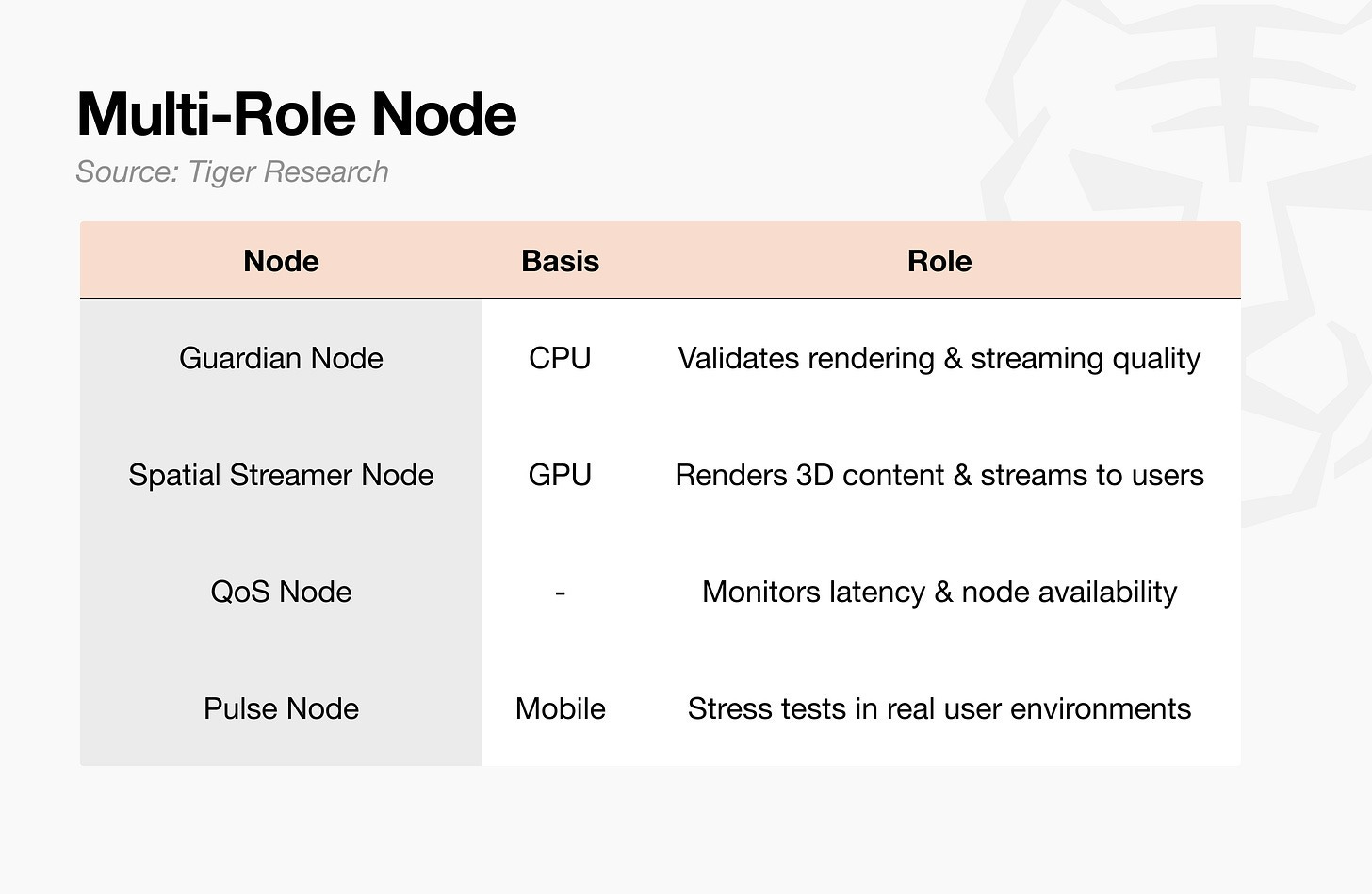
The rationale is that different functions require different hardware.
Rendering demands high-performance GPUs, but verification and monitoring can run on standard CPUs. If every node had to perform every function, even simple verification tasks would require expensive GPU hardware.
Higher entry barriers reduce the participant pool and slow network expansion. By separating roles, participants without GPUs can still contribute to the network, ultimately accelerating coverage growth.
Role separation also improves stability. A failure in one function has limited impact on others, and roles experiencing high demand can be scaled independently.
Additionally, KDDI, one of Japan’s largest telecom carriers, is providing hosting environments directly to node operators. This gives individual participants access to more stable infrastructure for running their nodes.
Growing the node count requires participation incentives. Most DePIN projects solve this through token issuance. This attracts early participants, but when token prices fall, the real value of rewards falls with them. Network growth and rewards are structurally disconnected.
Mawari chose a different path. Since its founding in 2017, the company has completed over 50 commercial projects with clients including KDDI, Netflix, BMW, and T-Mobile over eight years without issuing a token, generating average annual revenue of $1.5 million.
The scale is modest for an infrastructure startup, but the significance lies in having validated real demand and a revenue structure before any token launch. This revenue structure became the foundation for node reward design.
Rewards follow two tracks. Early operator rewards allocate a portion of total token supply to initial participants to stabilize the network in its early phase. Network activity rewards distribute 20% of net network revenue to node operators.
The more the network is used, the more operators earn. Because rewards are tied to actual revenue rather than token issuance, the real value of rewards is sustained as the network grows.
Most of Mawari’s technical challenges have been solved, positioning the Mawari Network as supply-ready ahead of demand. The remaining question is how quickly traffic and revenue will grow on top of this infrastructure.
The most direct variable is XR device adoption. In October 2025, Samsung launched Galaxy XR, co-developed with Google and Qualcomm, and Samsung and Google are also working on a smart glasses project with Gentle Monster. These are clear signals that major manufacturers are entering the XR market in earnest. However, consumer adoption speed is not a variable Mawari can control.
What Mawari can do is twofold: secure use cases ready to deploy the moment devices reach consumers, and build revenue streams beyond XR in parallel.
-
vTubeXR: A fan meeting platform where virtual idols and fans meet in 3D space. Accessible via smartphone, it generates network traffic even without XR devices.
-
Osaka Expo AI Guide: A 3D AI guide appears in front of visitors wearing AR glasses and provides real-time guidance. This also serves as a live environment for validating network performance with actual users.
-
Digital Human Aiko: Built with KDDI using AWS Wavelength and 5G, demonstrating real-time streaming capabilities on telecom infrastructure.
A project that has infrastructure in place before the market fully opens is positioned to capture demand first when it arrives. Mawari has already completed that preparation.
Mawari in one sentence: the infrastructure layer for XR, built over eight years ahead of market readiness.
Mawari has been actively developing technology and expanding infrastructure for eight years. But Mawari’s progress alone cannot drive large-scale growth. Ultimately, the XR device industry must grow and real product sales must accelerate before the infrastructure Mawari has built realizes its full value.
The core question for this project comes down to one thing: when the XR market opens, will Mawari’s infrastructure be ready? If it is, Mawari captures demand first. If it is not, that position goes to a competitor.
Mawari has bet on laying the groundwork before the market arrives.
Read more reports related to this research.This report was partially funded by Mawari Network. It was independently produced by our researchers using credible sources. The findings, recommendations, and opinions are based on information available at publication time and may change without notice. We disclaim liability for any losses from using this report or its contents and do not warrant its accuracy or completeness. The information may differ from others’ views. This report is for informational purposes only and is not legal, business, investment, or tax advice. References to securities or digital assets are for illustration only, not investment advice or offers. This material is not intended for investors.
Tiger Research allows the fair use of its reports. ‘Fair use’ is a principle that broadly permits the use of specific content for public interest purposes, as long as it doesn’t harm the commercial value of the material. If the use aligns with the purpose of fair use, the reports can be utilized without prior permission. However, when citing Tiger Research’s reports, it is mandatory to 1) clearly state ‘Tiger Research’ as the source, 2) include the Tiger Research logo following brand guideline. If the material is to be restructured and published, separate negotiations are required. Unauthorized use of the reports may result in legal action.