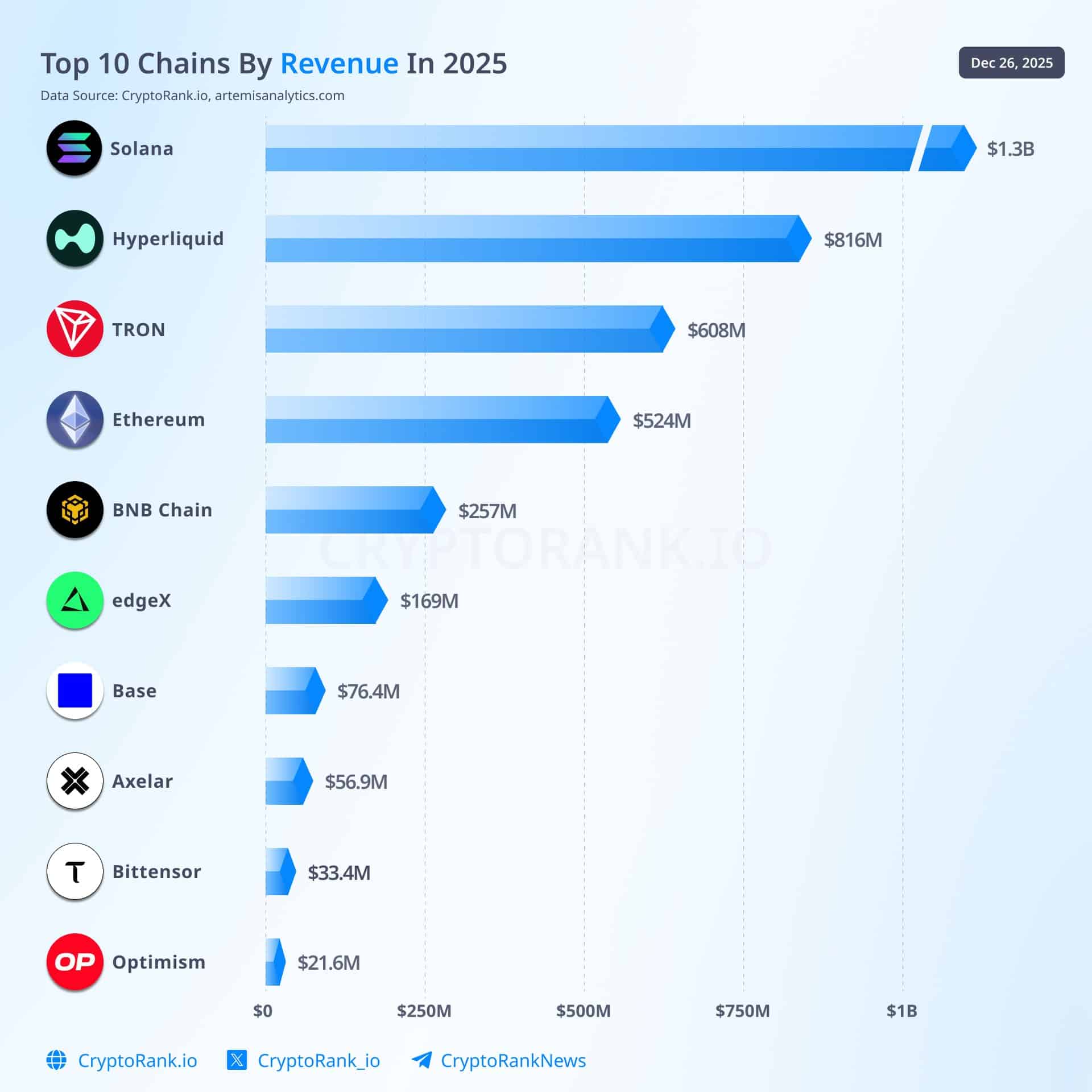

Two very different blockchain networks are emerging as the biggest revenue generators of 2025: Solana and Hyperliquid.
According to CryptoRank data, Solana generated $1.3 billion in revenue this year, placing it at the top of all blockchains. Hyperliquid is in second place with $816 million.
These numbers place the two networks ahead of capital-heavy chains, including Ethereum, which recorded nearly $524 million during the same period.
The ratings highlight a broader shift in 2025: on-chain value is increasingly captured through improved networks of execution and throughput rather than massive depth of liquidity.
Solana leads revenue with a stable capital base
Throughout 2025, Solana’s total value is unlocked It remains largely limited in scope. Its value ranges between approximately $7 billion and $12 billion, according to DeFi data.
Although there has been no sustained expansion in TFD volume, transaction volumes have remained consistently high, with several spikes mid-year.
This combination indicates that Solana is extracting more revenue per unit of capital, rather than relying on liquidity growth to pay fees.
High-frequency usage across decentralized exchanges, consumer apps, memecoin trading, and DePIN-related activities has directly generated fees.
Social sentiment data adds another layer to the picture. Sentiment around SOL has been extremely volatile this year, often oscillating between positive and negative territory and spending long periods near neutral.
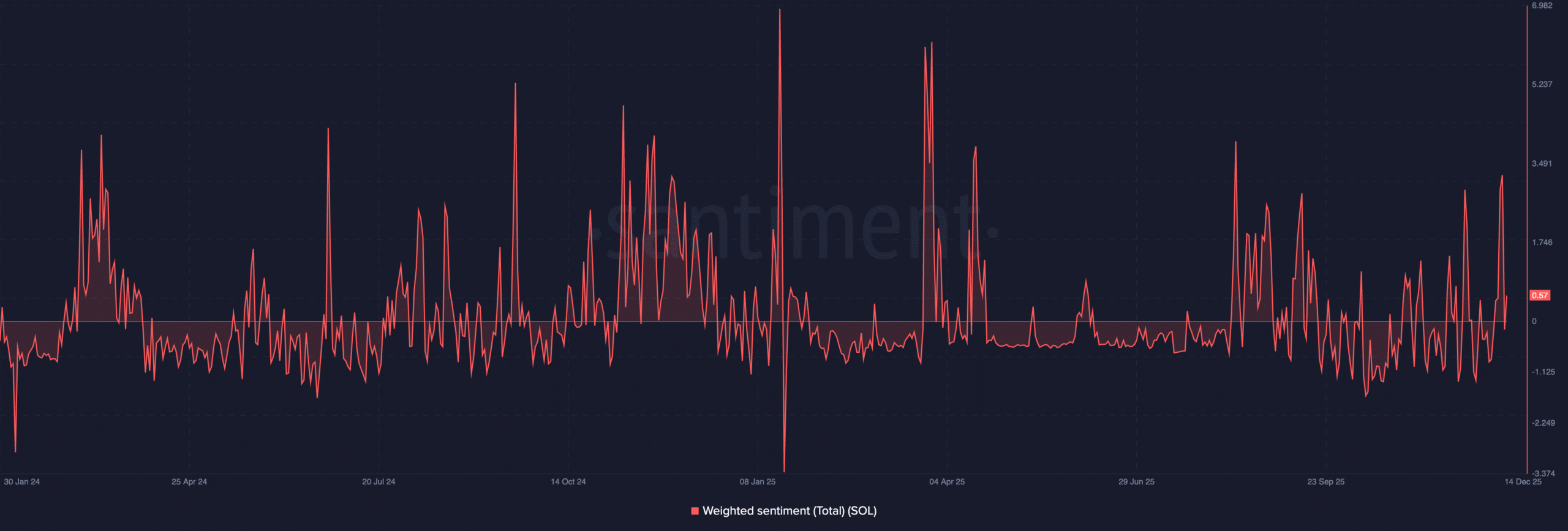
However, these shifts in sentiment had no apparent impact on usage or revenue.
The difference indicates demand driven by usage rather than narrative. This reinforces Solana’s position as a highly productive execution layer rather than a chain that relies on speculative enthusiasm.
Hyperliquid validates the specialized execution model
Designed as a specialized platform for derivatives trading rather than a general-purpose blockchain platform, Hyperliquid generated more revenue in 2025 than most major Layer 1 and Layer 2 networks.
TVL data It shows Hyperliquid’s capital locked up rising from about $2 billion early in the year to a peak of more than $6 billion before stabilizing near $4.1 billion.
Even after this decline, TVL remains roughly double its level at the beginning of the year, indicating that capital has remained stable despite changing market conditions.
At the same time, revenues remained high compared to the capital base. This suggests that Hyperliquid’s fee collection is supported by sustained trading activity rather than a one-off spike in trading volume.
Sentiment trends tell a similar story. While social sentiment around HYPE slowed in the second half of the year, approaching neutral or slightly negative levels, there was no similar collapse in TVL or revenue.
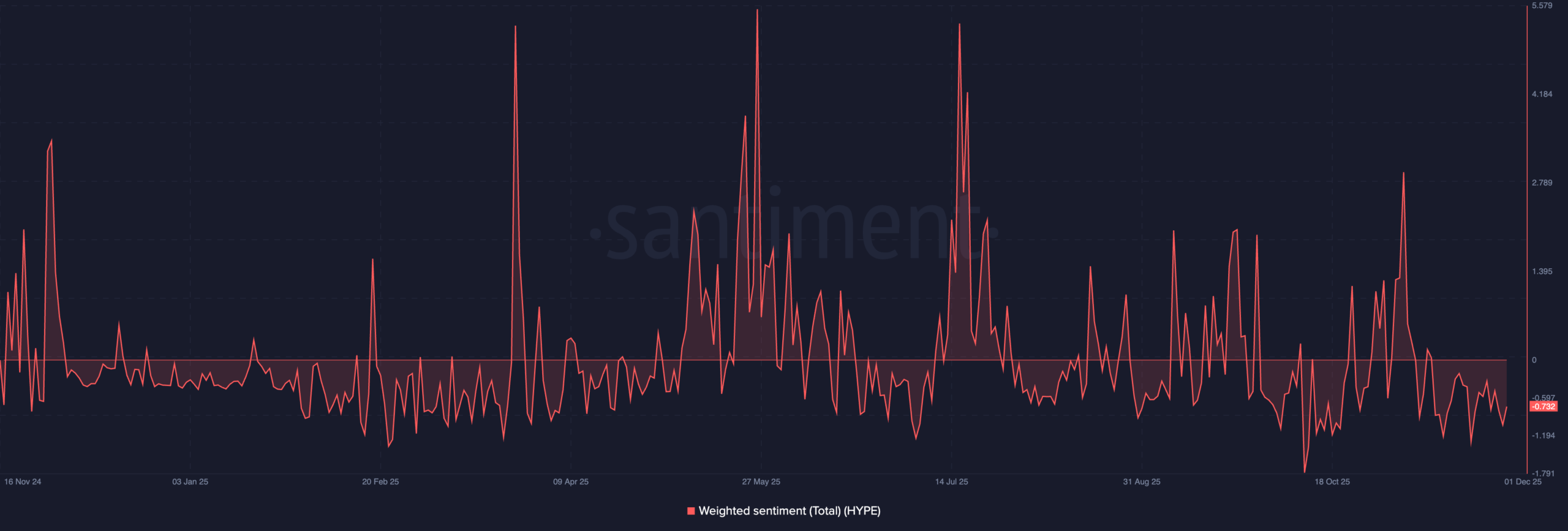
This flexibility suggests that traders continue to rely on the platform regardless of the broader market mood.
A broader shift in on-chain value capture
Taken together, the data show that in 2025, chains that prioritize execution quality and productivity will outperform those that rely on large but passive liquidity pools.
Solana represents the general-purpose end of this spectrum, offering broad application coverage with high transaction capacity. Hyperliquid is on the niche end, focusing almost exclusively on high-density derivatives trading.
Despite their differences, both networks turn activity into revenue more efficiently than many of their counterparts.
Final thoughts
- Solana and Hyperliquid’s revenue dominance in 2025 shows that execution quality and sustainable usage now drive on-chain value more than TVL growth or social sentiment.
- As capital efficiency becomes a more prominent differentiator, networks that continually convert activity into fees may continue to outperform larger but less productive chains.