
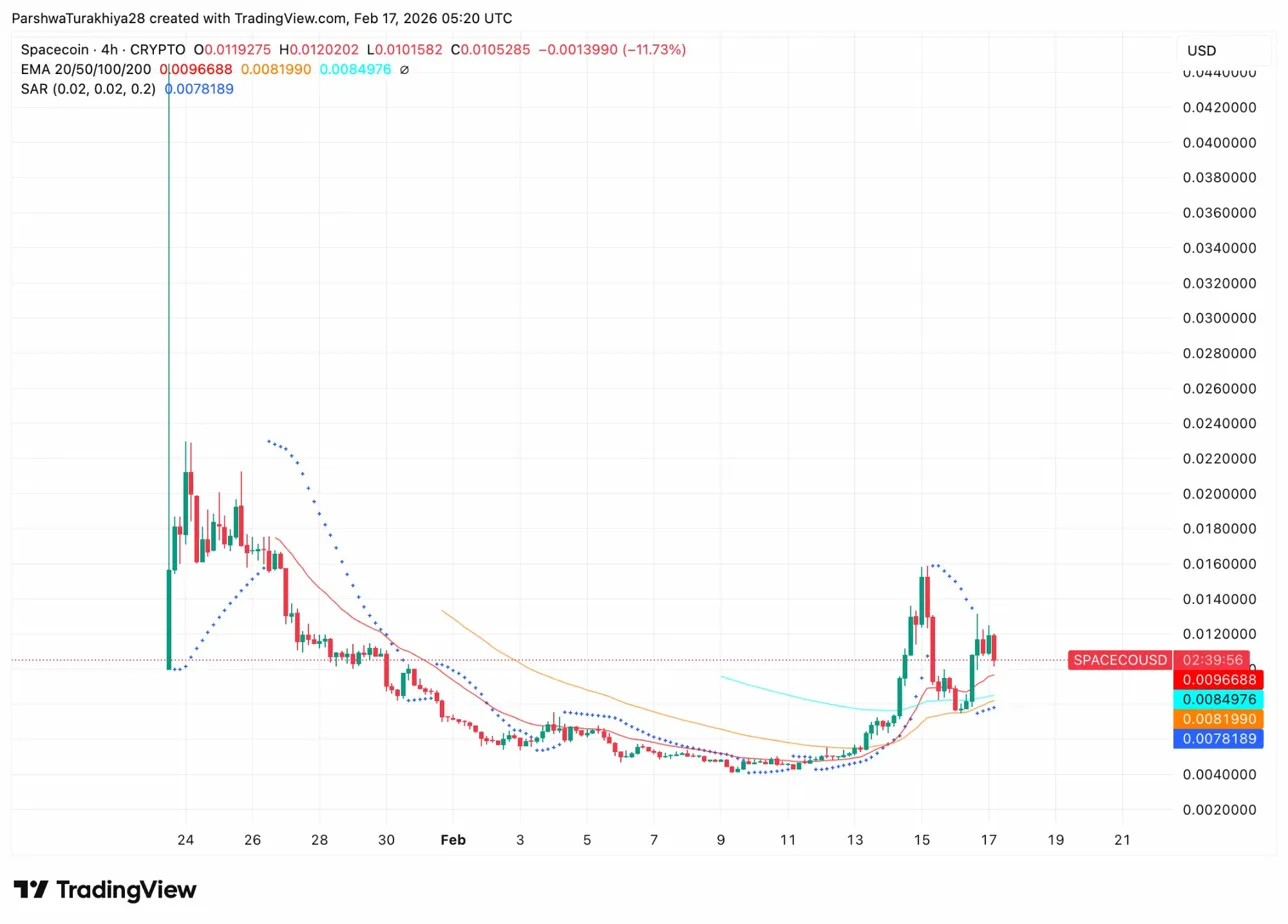
Spacecoin is arguably DePIN’s most ambitious project of early 2026 – building a constellation of blockchain-enabled satellites in low Earth orbit to provide internet access to the 2.6 billion people globally who have never been connected to the internet. Based on the Creditcoin blockchain, SPACE was launched on January 23, 2026, debuted at $0.02, reached an ATH of $0.02847, and has since corrected to around $0.010-$0.011, with a traded market capitalization of around $23 million against a fully diluted valuation of around $225 million.
SPACE shows early stabilization after a sharp post-launch correction. The token is trading at around $0.01053, and has already rebounded 135% from its all-time low of $0.004125. On the 4-hours chart, the 20 EMA at $0.00967 has started to curve higher, and the Parabolic SAR is at $0.00782 below the price – both are temporarily bullish. The 50 EMA ($0.00820) and 100 EMA ($0.00850) are converging into a support cluster worth watching.
However, the price is still well below the 200 EMA, and the bearish Bollinger band indicates resistance in the $0.014-$0.016 range. The bulls need a clean retrieval of $0.012 on volume to confirm the recovery. However, missing the $0.008 support opens the door back towards the ATL region.
There are two factors that will determine SPACE’s price action for 2026. The first is the token’s second season opening that begins in late February, putting real pressure on supply. With only approximately 10% of the total 21 billion tokens currently in circulation, the risk of dilution is significant and traders must price this in.
The second is the project deal pipeline. Government agreements or telecom agreements signed in Nigeria, Kenya, Indonesia or Cambodia will be real reclassification events. The World Liberty Financial partnership adds political insight, and the Midnight Foundation’s collaboration for zero-knowledge private messaging expands the story beyond basic communication. Most importantly, two satellites – CTC-0 and CTC-1 – have already transmitted verified blockchain transactions from orbit, giving Spacecoin hardware a credibility that most DePIN projects lack. If Starmesh VPN gains traction and the government beta is confirmed, an end-of-year target of between $0.025 and $0.035 would be realistic.
| year | Minimum price | Average price | Maximum price |
| 2026 | $0.008 | $0.020 | $0.035 |
| 2027 | $0.018 | $0.045 | $0.080 |
| 2028 | $0.040 | $0.090 | $0.150 |
| 2029 | $0.080 | $0.160 | $0.280 |
| 2030 | $0.130 | $0.250 | $0.420 |
2027 forecast ($0.018 – $0.080): Assuming unlock pressure eases and at least one government telecoms deal is contracted, SPACE could usefully reassess. The launch of additional satellites and increasing numbers of Starmesh users would validate this technology. An average of $0.045 requires the DePIN sector to maintain momentum and Spacecoin to demonstrate measurable internet connectivity in emerging markets.
2028 forecast ($0.040 – $0.150): With the World Economic Forum forecasting that DePIN markets will reach nearly $3.5 trillion by 2028, high-quality satellite infrastructure projects could attract institutional interest. A multi-satellite constellation providing connectivity commercially in Africa or Southeast Asia would justify the higher range. Competition from Starlink remains the primary headwind.
2029 forecast ($0.080 – $0.280): By this point, node operator backlog—as operators must lock SPACE to operate network capacity—can significantly reduce circulating supply. If monthly internet costs reach the target amount of $1-2 per user across many markets, revenue-based assessments become credible.
2030 Estimates ($0.130 – $0.420): The long-term bull case depends on Spacecoin becoming a legitimate global satellite infrastructure. The $0.25 average assumes contracted partnerships with established telcos, a full operational constellation, and a broader crypto bull cycle. At the current market cap of $23 million versus a $1 trillion TAM, the asymmetry is real – but so is the execution risk.