
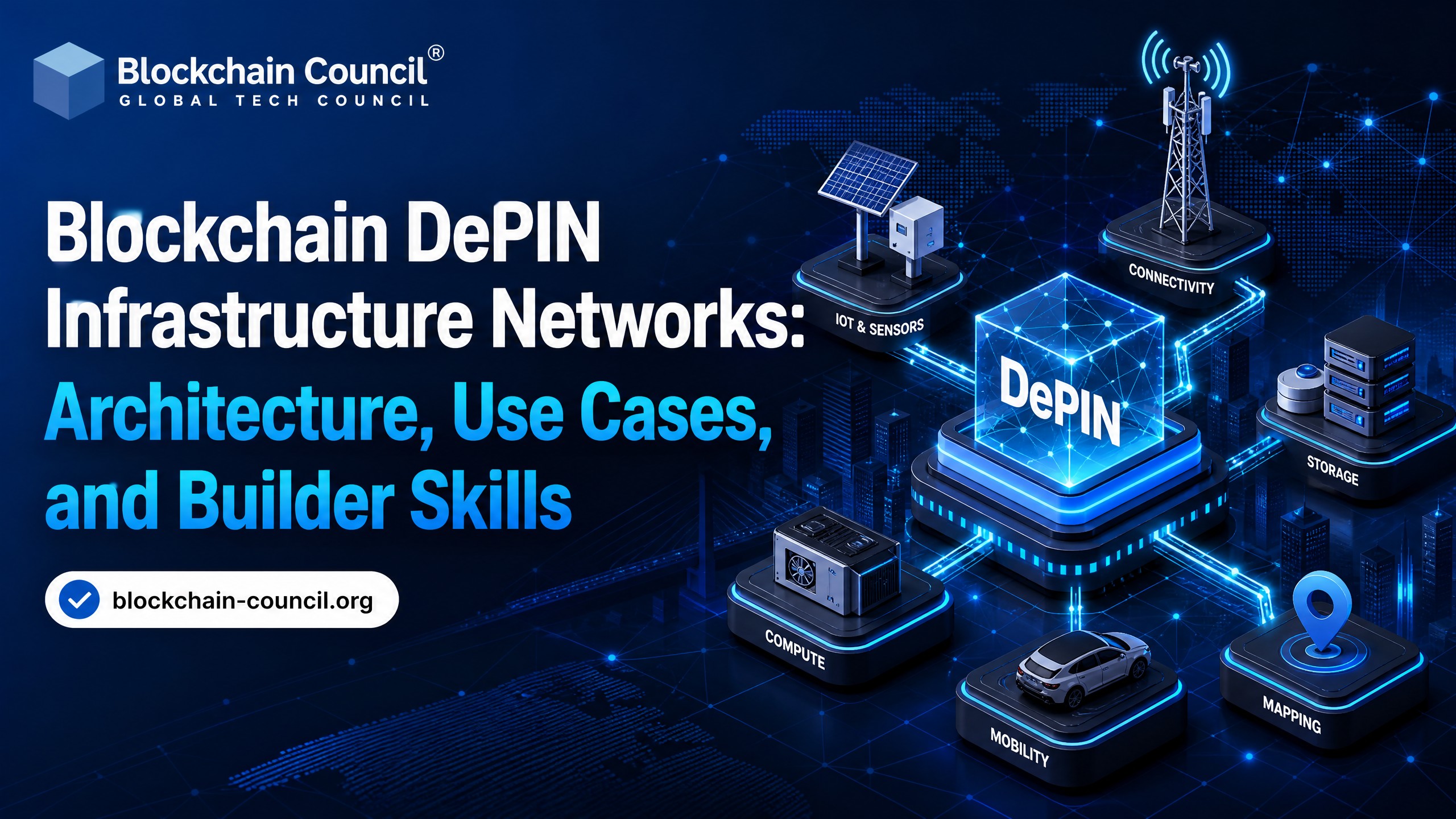
DePIN Blockchain Infrastructure Networks Using blockchains, tokens, and community governance to coordinate physical infrastructure: wireless hotspots, GPUs, storage nodes, energy assets, sensors, and mapping devices. The idea is easy to describe and difficult to implement. Instead of one company purchasing each tower, server, or sensor, multiple participants contribute resources and get paid when the network verifies useful work.
DePIN stands for Decentralized physical infrastructure networks. It is now treated as a distinct category of Web3 infrastructure by companies like JP Morgan and a16z crypto, by tool providers like QuickNode and The Graph, and by academic researchers writing about standard DePIN systems. The benefit is not theoretical. Projects in wireless communications, computing, storage, mapping, and energy are already showing how cryptographic incentives can coordinate devices in the real world.
What is Blockchain DePIN Infrastructure Networks?
The DePIN network is a blockchain-based system for managing physical or automated resources. Participants turn on devices or contribute capacity, then receive metered service tokens. This service could be network coverage, uptime, bandwidth, storage availability, GPU compute, verified sensor data, or power delivered.
Blockchain is not hardware. It is the coordination layer. Smart contracts record payments, incentives, governance decisions, and, in many cases, proof of a resource’s availability or use.
Basic characteristics
- Open sharing: A user can join by deploying a hotspot, GPU, sensor, storage node, or other supported device.
- Symbolic incentives: Contributors earn tokens based on network rules, not private contracts with a single operator.
- Transparent accounting: Payments, rewards, and governance procedures can be inspected on-chain.
- Shared ownership: Many DePIN protocols use governance tokens or DAO-style voting to determine promotions and incentive changes.
- Verification of the physical world: The hard part is proving that the real work happened outside the blockchain.
This last point is important. The token can record a reward, but it cannot directly tell whether the hotspot actually provides coverage or the GPU has completed the task. DePIN networks need telemetry, cryptographic proofs, or reliable verification systems to fill this gap.
How the DePIN structure works
Most DePIN blockchain infrastructure networks have more moving parts than a standard DeFi implementation. You connect devices, users, wallets, contracts, indexing services, and sometimes regulators. The process architecture usually includes the layers below.
Blockchain and smart contracts
The series deals with settlement, symbolic logic, governance, and sometimes reputation. Public L1 and L2 networks are popular options because developers can reuse existing wallets, RPC providers, explorers, and smart contract tools.
For builders, the choice of chain is not cosmetic. Gas, final, throughput, and wallet support costs all affect whether or not micro-appliance payments make sense. The Ethereum mainnet, with a chain ID of 1, is often too expensive for small, frequent settlements. Many teams push high-volume activity to the second level or application-specific thread, and then periodically reconcile the higher value state.
Device identity and access control
JPMorgan has pointed to decentralized identity as a key component of DePIN systems. Devices need verifiable identities so the network can determine which devices are allowed to submit work, claim rewards, or access private services.
In practice, this could mean a hardware secure item, a DID document, location telemetry, or a device history associated with the wallet. Skip this layer and Sybil attacks become cheap. Anyone can spin counterfeits and farm rewards.
Oracles, telemetry and proof of work performed
DePIN proof systems vary by sector. The wireless network may verify coverage through location checks and traffic routing. The storage network may use proof of replication or proof of storage. The computing network may require workload validation, benchmark tests, or verification of results.
This is where many early designs fail. You cannot pay only for the claimed uptime. People will emulate the runtime. Pay for a useful, independently verifiable contribution instead.
Indexing, analytics and data availability
DePIN applications need fast readings. Users want to see node status, profits, coverage maps, waiting times, and quality of service. Raw contract calls are not enough. Indexing layers such as The Graph, onchain analytics systems, and offchain databases are often used together.
A small but painful detail: If you use Ethers v6, many values will revert to their original values bigint. Code written for Ethers v5 BigNumber Often interrupted with TypeError: Cannot mix BigInt and other types. In a bounty account, this error can quietly destroy your dashboard accounts before they even reach the contract.
Key use cases of DePIN
Wireless connectivity and connectivity
Decentralized wireless networks allow individuals to deploy hotspots for LoRaWAN, 5G, or other communication services. Helium is the most famous example cited in DePIN discussions. The promise is better coverage through community dissemination, especially in places where building traditional connections is slow or expensive.
The trade-off is quality control. A carrier-grade network needs predictable coverage, maintenance, and compliance. Token rewards can attract devices, but they do not automatically create enterprise-level service.
Computing infrastructure and artificial intelligence
DePIN GPU networks aggregate distributed computing for AI inference, training support, 3D rendering, and video workloads. This category has drawn attention because demand for GPUs has risen sharply with generative AI.
Use DePIN when tasks can tolerate variable service providers, verification overhead, and network latency. Don’t use it blindly for workloads that need strict data locality, predictable low latency, or sensitive model weights without a strong design for secrecy.
Storage and data networks
Decentralized storage systems distribute files across many nodes, then reward service providers for capacity and availability. These networks can improve resilience and censorship resistance, but retrieval speed, redundancy settings, and data privacy must be carefully designed.
For enterprise use, encryption is non-negotiable. Storing data on decentralized nodes does not make it private by default.
Domestic energy and resource markets
Energy DePIN models can support peer-to-peer energy trading, solar generation tracking, electric vehicle charging coordination, and grid balancing incentives. JP Morgan has flagged energy grids as a promising area because it involves many participants who need reliable settlement and shared data.
This is also one of the most organized categories. The token model cannot bypass the rules of the energy market. Builders need legal and network expertise early on, not after trial.
Mapping, sensors and machine data
Mapping and sensor networks reward people for collecting road images, weather data, environmental readings, parking availability, or industrial telemetry. The model works best when the data has clear buyers and when the network can detect low-quality or fraudulent submissions.
Bad data is worse than no data. If your incentive model pays for volume without checking for accuracy, you will receive spam.
Why DePIN is gaining institutional attention
DePIN is attractive because it makes use of underutilized resources. Spare GPUs, rooftop antennas, local sensors, and storage can become productive network assets. a16z Crypto has argued that this model could challenge opaque infrastructure monopolies by giving users and operators a direct economic role.
JP Morgan frames blockchain as a common data and payments protocol for various infrastructure participants. This view becomes even more interesting when you deal with hardware. Think electric vehicle chargers, self-driving vehicles, factory robots, and AI agents that pay for connectivity, computing, or energy without manual billing.
However, do not treat every DePIN project as inevitable. The model only works when symbolic incentives match real demand. If rewards came primarily from issuing tokens and not from paying users, the economy would not survive.
Key Challenges of DePIN Blockchain Infrastructure Networks
- Evidence verification: The network must prove its real work, not just its alleged work.
- Token sustainability: Rewards need a path towards service revenues, not just emissions.
- Hardware operations: Devices malfunction, move, lose power, or are misconfigured.
- Systems: Communications, energy, privacy and securities rules may apply.
- User experience: Non-encrypted users will only be able to manage gases, bridges, and seed phrases for connection or storage use.
- protection: Smart contracts, device firmware, APIs, and reward logic create attack surfaces.
Skills professionals need for DePIN
If you want to work on DePIN, combine your knowledge of blockchain and the field of physical infrastructure. Solidity alone is not enough. You need to understand hardware, data pipelines, incentive design, and security.
Helpful learning paths include:
- Smart contract development: Learn Solidity 0.8.x, ERC-20 token mechanics, access control, upgrade patterns, and auditing basics. Blockchain Council Certified Smart Contract Developer™ Maps for this work.
- Blockchain architecture: Study of design, settlement, portfolios, bridges, and indexing at the first and second levels. the Certified Blockchain Engineer™ Helps professionals who design infrastructure systems.
- Blockchain basics: If you’re new to Web3, start with Certified Blockchain Expert™ Before moving on to the proprietary DePIN structure.
- Artificial Intelligence and Computational Markets: For GPU networking, pair blockchain skills with AI infrastructure knowledge. the Certified Expert in Artificial Intelligence (AI)™ Useful for understanding AI workloads and deployment limitations.
- Thinking about a Web3 product: the Certified Web3 Expert™ Suitable for product managers and founders evaluating DePIN business models.
Future Outlook: Benchmark DePIN and Machine Economics
Academic work on modular infrastructure for DePIN points to more composable combinations. Instead of each project building identity, payments, device ledgers, storage, and governance from scratch, teams can combine specialized modules.
This trend makes sense. DePIN needs standard components: device identity, proof verification, payment channels, data availability, governance, and analytics. Better modules reduce wasted engineering time and make audits easier.
The long-term trend is machine-to-machine leveling. The sensor pays for bandwidth. The AI agent rents GPU time. Self-driving car drives to charging station. These use cases need low-cost payments, trusted identity, and offline settlement when the connection drops.
What you should build or learn next
Start small. Build a prototype that registers the hardware wallet, accepts location telemetry, verifies a simple contribution rule, and pushes test token on an L2 testnet. Then add indexing and dashboard. You will learn more from one practical guide than from reading ten outstanding white papers.
If your goal is to professionally design or audit DePIN blockchain infrastructure networks, solidify your base first: blockchain architecture, smart contracts, security, and token economics. The next practical step is to pair the Blockchain board Certified Blockchain Developer™ or Certified Smart Contract Developer™ Through practical work in IoT, cloud infrastructure or AI computing systems.