
original | Odaily Planet Daily (@OdailyChina)
Author | Azuma (@azuma_eth)
I’ve seen rug pulling projects before, but I’ve never seen one this brazen.
This is real community feedback on Puffpaw, a newly launched DePIN project.
Last week, the project, which had previously raised $6 million but had been dormant for so long due to a lack of interest in its ecosystem and narrative, suddenly announced the launch of its own token and airdrop — but this wasn’t a real effort to reward the community; All actions were aimed solely at capturing value on another path: the prediction market.
Previously popular project
Although his current behavior is highly inappropriate, Puffpaw was once a legitimate enterprise that guaranteed funding. As a decentralized physical infrastructure network (DePIN) built on Berachain, Puffpaw promoted the “Vape-to-Earn” concept, aiming to incentivize users with tokens using smart e-cigarette devices to track smoking data.
Leveraging the previously gained consumer hardware narrative and early Berachain ecosystem momentum, Puffpaw has raised a $6 million seed round in 2024, led by Lemniscap and joined by notable institutions including Folius Ventures and Spartan Group. It subsequently attracted significant community funding through the pre-sale of its vape smart contracts and the launch of its original NFTs.
However, as the hype around the Berachain ecosystem faded and the DePIN narrative receded, Puffpaw gradually disappeared from public view, with project progress almost halting and community maintenance entering a long-term silence.
Coin-launching raid and outrageous airlocks
Just as the community was about to write off the project as dead, Puffpaw suddenly came back to life last week — after more than six months without an update — to announce the launch of a vape token and airdrop it.
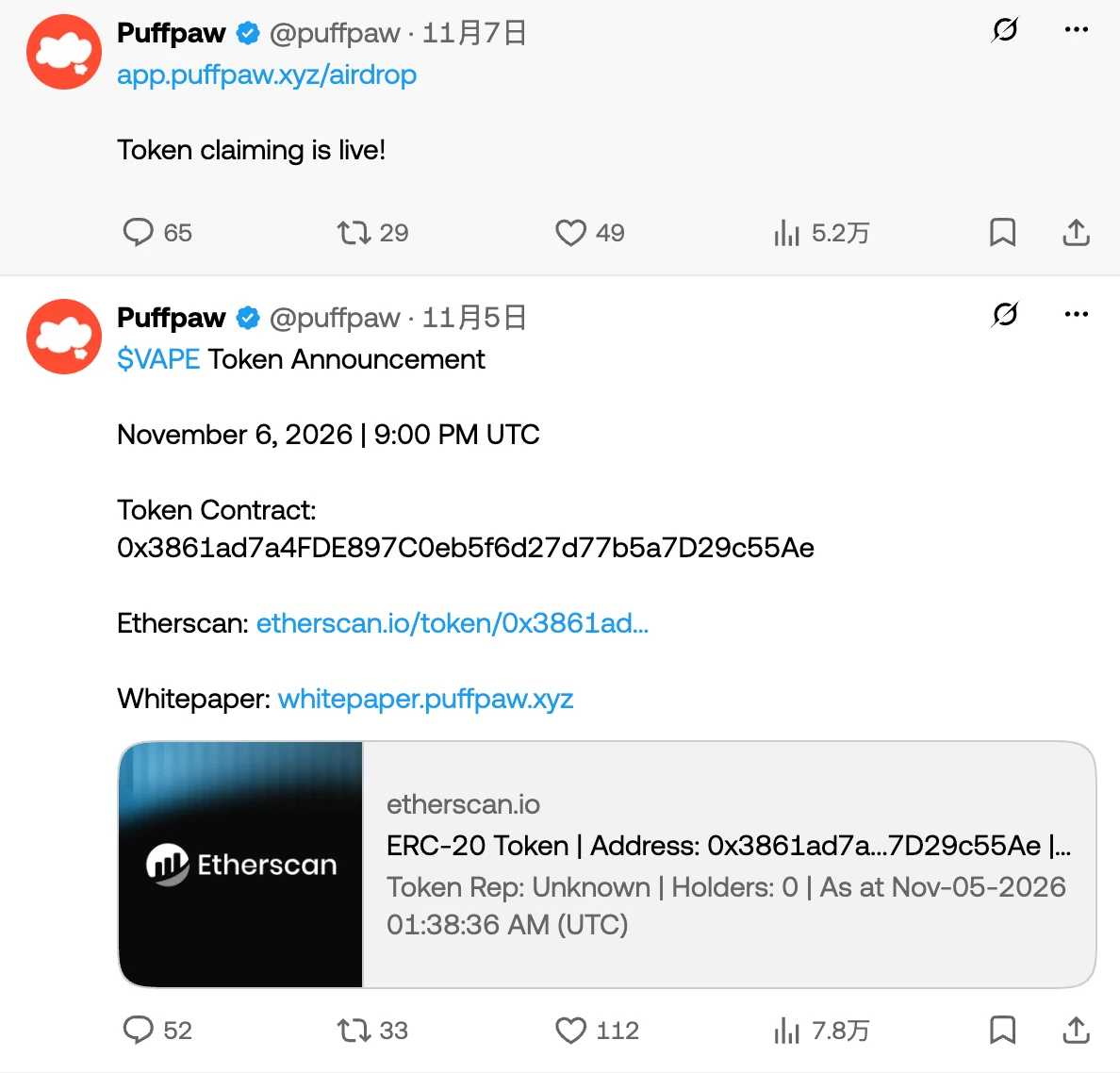
However, what the early supporters were waiting for was not surprise, but outright humiliation.
As a $6 million funded project, VAPE was launched without any support from centralized exchanges (CEXs), with a minimal liquidity pool (about tens of thousands of dollars) spread on-chain via DEXs.
The airdrop design is even more terrible. Many early adopters who started interacting in 2024 spent $200-$300 to purchase Genesis NFT hardware or devices, yet received an airdrop worth only tens of dollars. Even more infuriating is that this meager airdrop comes with a linear vesting period of 156 weeks (about three years).
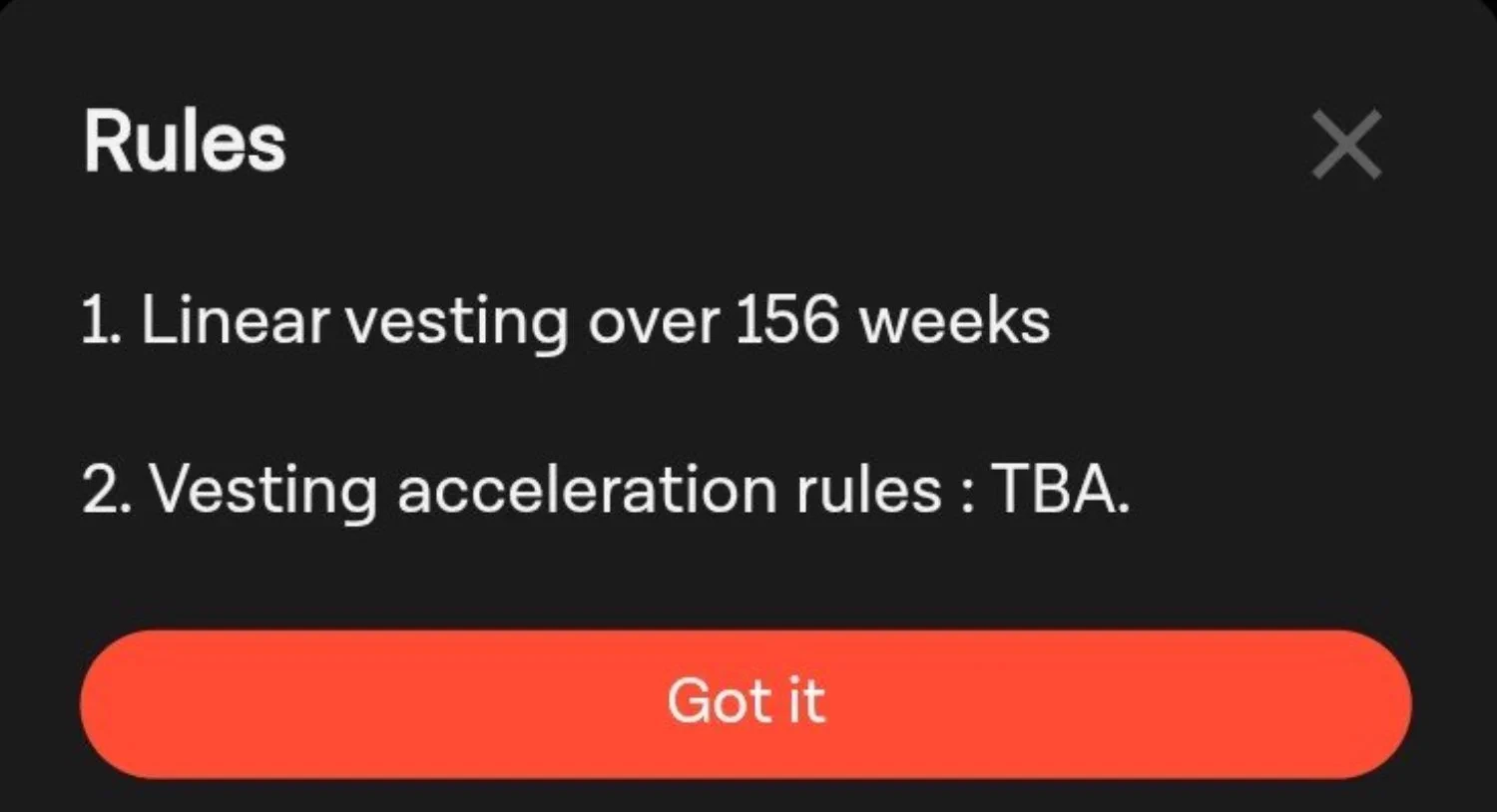
This means that the real selling pressure at the open is deliberately isolated, as the project team holds almost all of the tokens – on-chain data shows that addresses linked to the team control 97% to 99.88% of the token’s circulating supply.
Why are you doing this? The trick is all in the prediction market.
Since Puffpaw has no intention of listing on an exchange or gradually exiting through secondary market liquidity, why would we go through the trouble of launching a token and conducting an airdrop? The answer is not in the DEX, but in another market: Polymarket.
Polymarket previously listed an event asking whether Puffpaw’s FDV value one day after listing would exceed $50 million, $100 million, $200 million, $300 million, or $400 million. The Puffpaw team’s goal in controlling the token supply was specifically to manipulate the market value of the token and profit from bets on the event.
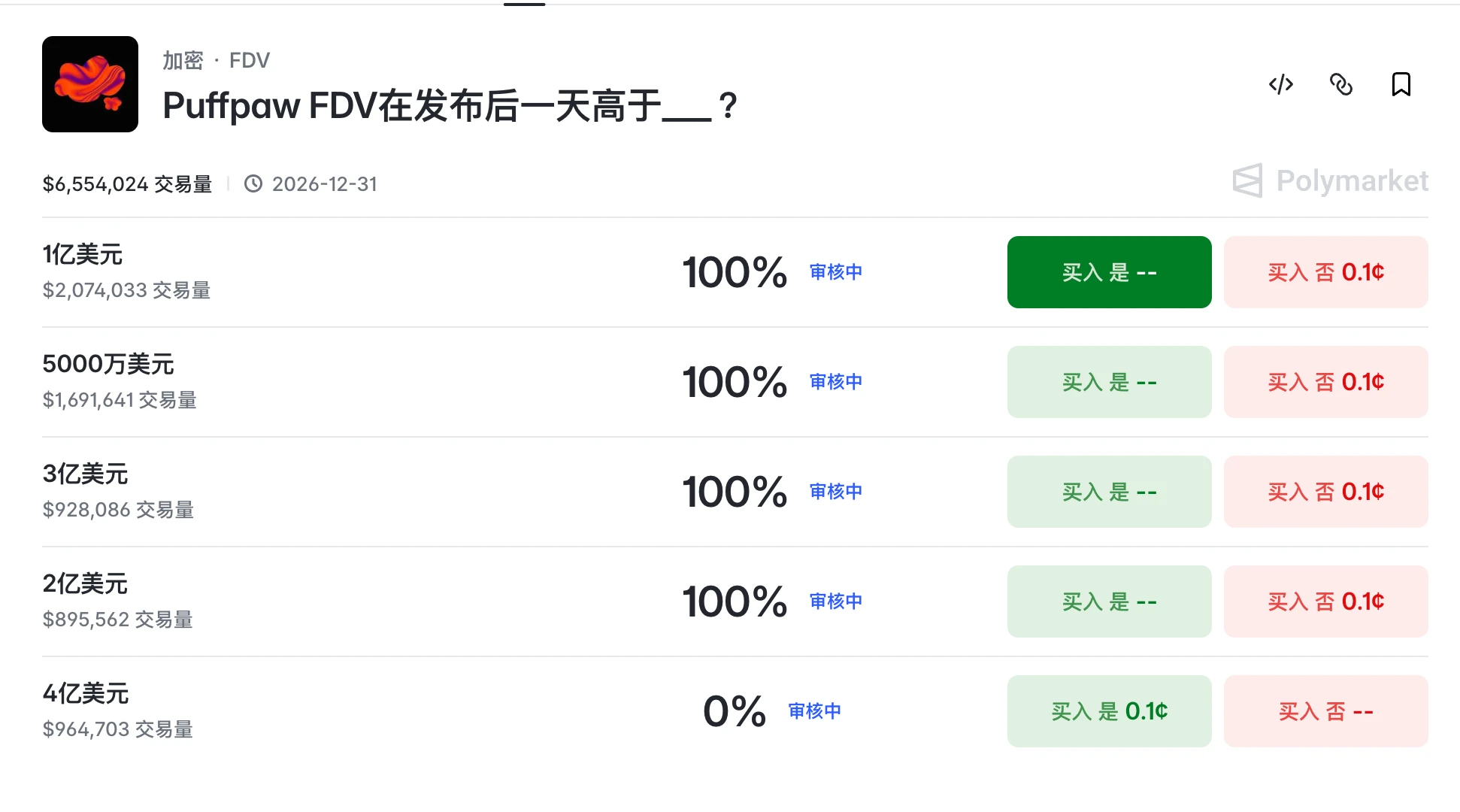
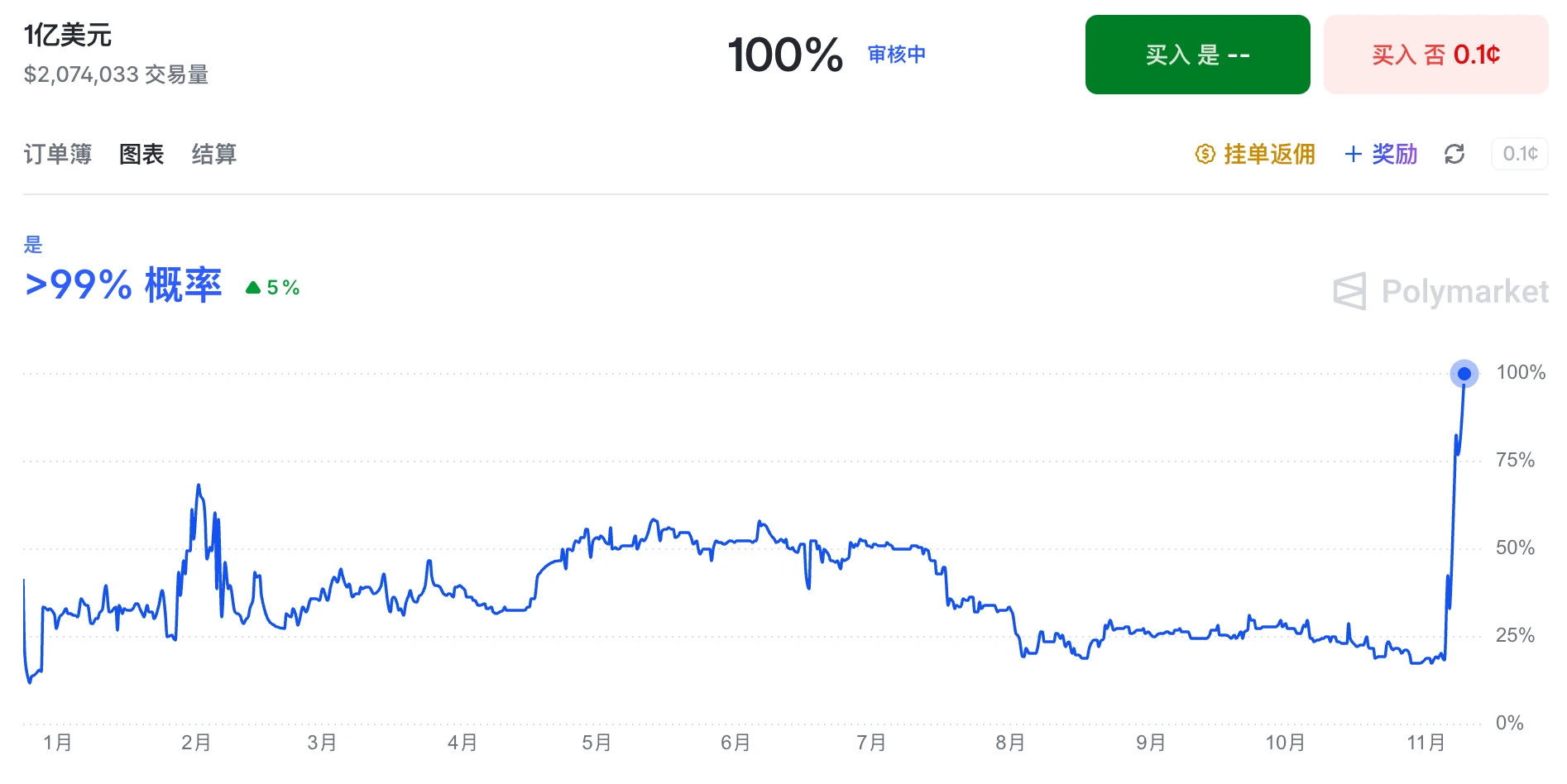
Previously, due to Puffpaw being inactive for a long time and the lack of any token launch, the probability of a YES option for related events on Polymarket was very low across all levels (event expires at the end of 2026; if no token launch occurs, it will be considered NO). This allowed the Puffpaw team to acquire YES shares across all levels at a very low cost, and then use the fully controlled token to precisely “draw the line.”
This is also confirmed by the price performance of VAPE after its listing. On the first day after listing the token, VAPE clearly showed a “stairs” trend (with almost no upper or lower shadows on each candle, indicating deliberate and gradual price manipulation), resulting in a closely controlled FDV of just under $400 million.
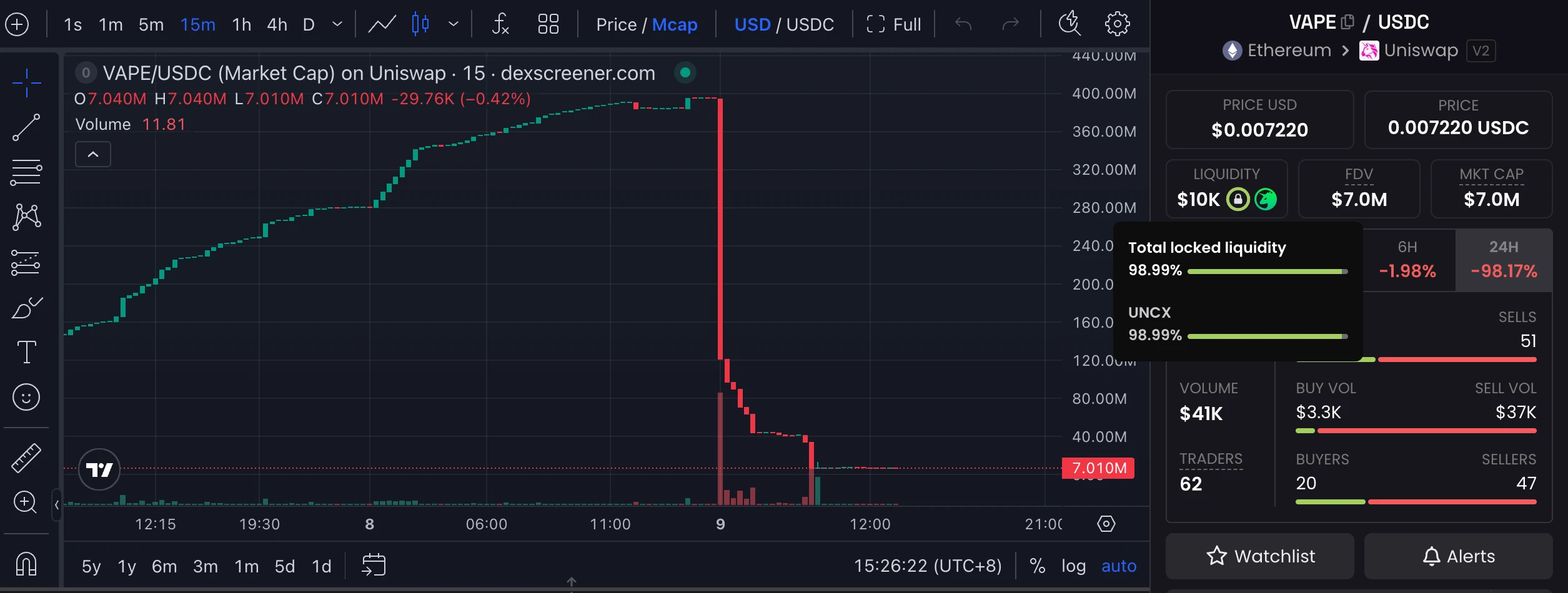
Once the price held long enough to meet prediction market conditions, the vape fulfilled its historic purpose—immediately followed by an unapologetic dump. Due to the extremely shallow liquidity pool, a small amount of token sales directly penetrated the bottom of the pool, causing VAPE’s FDV to drop from around $400 million to just $7 million.
During this process, since the on-chain pool did not have retail buying depth, the project team did not earn much money from the token sales itself – but the collapse of the token price was no longer important to them, as the real profit was already secured in the prediction market.
This is not an attempt by the community to smear Team Puffpaw – on-chain data analyst Atlantis Liquidity has uncovered more tangible data anomalies: On Polymarket’s Puffpaw FDV prediction market, 1,285 wallets hold positions, of which a staggering 1,259 wallets (nearly 98%) have never traded on any other market on Polymarket – completely new accounts created solely to bet on Puffpaw’s FDV, It is not difficult to guess who is behind them.
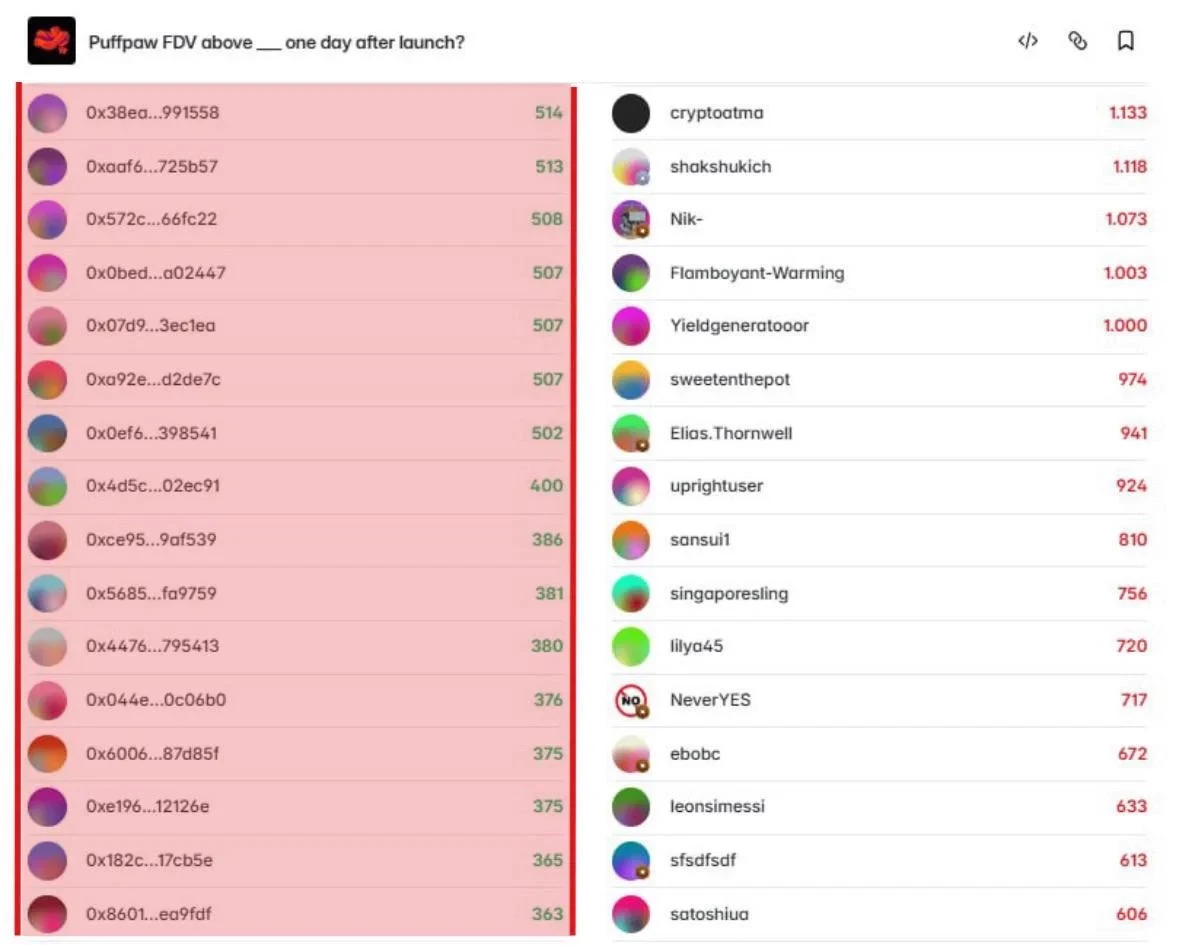
Polymarket has not yet been settled, and the community continues to raise objections.
As of this writing, the odds of the $50M, $100M, $200M, and $300M tiers on Polymarket have risen to 100%, while the odds of the $400M tier have dropped to 0%, indicating that Puffpaw’s extraction strategy is complete. However, due to the very extreme nature of this move, the final settlement of funds was halted midway.
In the face of such blatant manipulation, Polymarket’s rival side (traders betting on NO) and the community have joined forces to repeatedly challenge the settlement proposal.
The Polymarket page states that the results of the relevant event have been disputed twice. Under the Polymarket oracle mechanism, when the market outcome faces two consecutive disputes, all five submarkets will enter the final review phase, and the outcome will be determined by the vote of UMA token holders. This round of voting is expected to end on November 11.
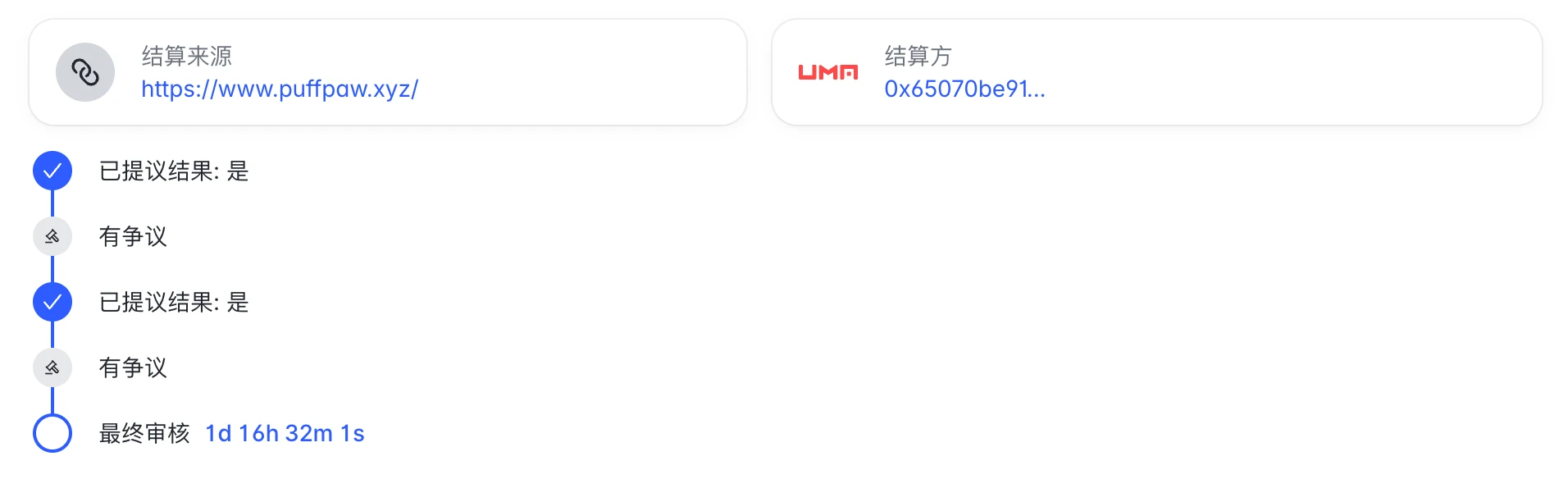
Regarding this ruling, society is currently engaged in a heated debate between “procedural justice” and “substantive justice.”
Those who oppose paying reparations (support “no”) argue that allowing settlement in the face of such malicious manipulation and apparent fraud would encourage further wrongdoing and even incentivize more projects to follow this path. Those who support the push (Support Yes) argue that although Puffpaw’s actions were deeply disgraceful, if a vape technically meets Polymarket’s stated criteria for “listing and FDV thresholds,” it should be settled as a yes; Retroactively eliminating the rule and declaring “no” simply because it “looks like a scam” would undermine the contractual certainty of prediction markets.
Regardless of how the Arab Maghreb Union ultimately governs, this whole farce was ridiculous enough. Whether Puffpaw’s carefully orchestrated scheme to get something for nothing will succeed in putting money into their pockets will soon be answered.