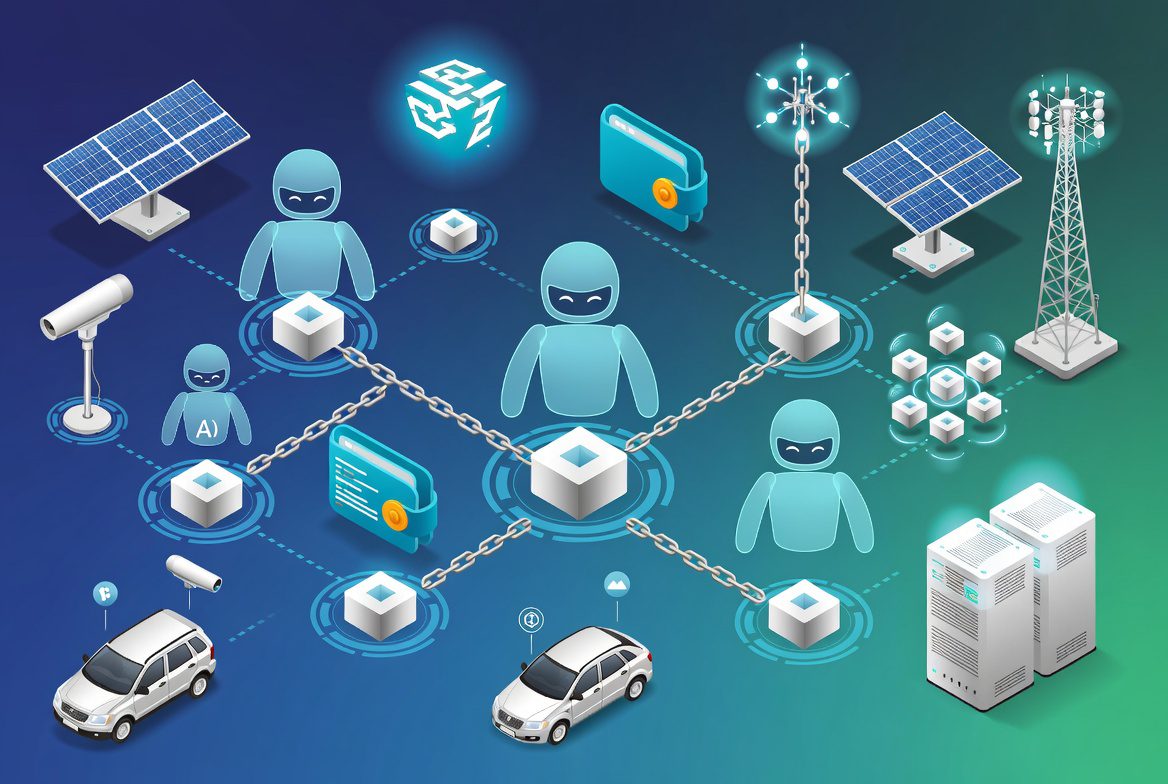
The convergence of artificial intelligence and blockchain technology has ceased to be a theoretical possibility and has become an evolution of digital infrastructure. The two technologies do not compete with each other; Rather, they resolve each other’s structural constraints. While artificial intelligence provides the ability for reasoning, pattern recognition, and independent decision-making, blockchain provides an immutable ledger, cryptographic verification, and the ability to settle value without intermediaries.
This integration gives rise to new business models, decentralized infrastructures, and economic agents able to operate independently. These are some of the key use cases where the two technologies actually converge.
Artificial Intelligence + Blockchain 2026
One of the most important developments in 2026 is the emergence of artificial intelligence agents that operate as autonomous economic entities. To work effectively, these agents need to pay for services, execute transactions and coordinate with each other. In this scenario, blockchain technology provides them with independent digital wallets, stablecoins as the unit of account and smart contracts as the implementation layer.
From a technical point of view, this model requires the agent to control its private keys, integrate transaction signing logic into the decision-making cycle and use on-chain mechanisms capable of validating its actions without relying on central custodians.
Report Agent flywheelProduced by Galaxy Research, the model describes this model as the foundation for future companies that have no human employees, where capital flows, negotiation and execution of DeFi strategies take place entirely on the blockchain.
Cross-Chain Agent Markets: Coding AI Services
Another fastest-growing area is decentralized marketplaces for AI agents. Projects like Virtuals allow each AI agent to be tokenized, facilitating partial shared ownership and automatic distribution of revenue generated by its activity.
With over 650,000 owners and a market capitalization approaching $915 million, one of the most popular use cases is Illuvium, where AI-based non-playable characters (NPCs) carry out learning and decision-making processes that are recorded and verifiable on the blockchain.
This architectural model explicitly separates the inference process, which remains off-chain for reasons of computational cost, from the resulting outputs and transactions, which are recorded on-chain to ensure verifiability.
DePIN Networks for Distributed AI Computing
Training and inference of AI models requires massive amounts of graphics processing (GPU) capacity. Decentralized Physical Infrastructure Networks (DePIN) seek to solve this bottleneck by pooling idle computing capacity distributed around the world. Io.net already aggregates more than 100,000 GPUs on Solana, providing competitive costs compared to centralized providers like AWS.
For its part, Render added an additional 60,000 GPUs from the Salad Network through proposal RNP-023, using its native token as a settlement mechanism between compute capacity providers and consumers. The technological value of this approach lies in coordinating heterogeneous and geographically distributed resources through token incentives, eliminating the need for a central coordinator.
Symbolic data infrastructure for model training
The quality of an AI model directly depends on the data on which it was trained. In this area, blockchain technology provides traceability and control over the source of information and monetization mechanisms. Ocean Protocol runs on Ethereum and other compatible networks, tokenizing access to data sets through the OCEAN token. It also includes staking mechanisms that serve as a signal of quality and trust regarding the available datasets.
This system creates a data market where economic incentives are aligned, as those who contribute low-quality or fraudulent information can lose the capital deposited as collateral.
In a complementary way, Fetch.ai provides the infrastructure for Software agents To execute tasks independently within this ecosystem.
Machine learning models applied to on-chain forensic analysis
Artificial intelligence also plays an essential role in monitoring the integrity of blockchain networks themselves. Arkham Intelligence applies machine learning algorithms to the transaction graph to de-anonymize wallets, track fund flows, and classify the behavior of different addresses.
The results are then integrated into the intelligence marketplace where analysts can monetize their research. This is one of the clearest examples of AI acting as an audit and regulatory compliance layer for information that blockchain already publishes transparently and immutably.
Smart contracts conditional on artificial intelligence models
In business, a new technological pattern is beginning to take hold: using the output generated by an AI model as a condition for executing a smart contract.
In practice, these models can recommend automatic recall of expired products, fulfill orders, payments, purchase inventory when certain thresholds are reached, automatically resolve disputes or choose the most sustainable transportation method.
The main technical challenge remains the so-called oracle problem: how to reliably transfer inference performed off-chain, which is computationally expensive, to a deterministic, verifiable environment such as the Ethereum Virtual Machine (EVM) or other blockchain platforms.
Supply chain traceability with cryptographic verification
The integration of AI and blockchain technology is also transforming traditional supply chains. Both technologies allow processes based on paper documents to be replaced with shared digital records that can be verified through cryptography and can be used by artificial intelligence models to generate predictions.
One of the most relevant examples is tracking carbon emissions at the product level or even at the individual part level. Each chain of custody event is recorded on the blockchain and an AI model then analyzes that data to create auditable metrics around decarbonization processes.
New consensus mechanisms: proving intelligence
The convergence of AI and blockchain is also reaching decentralized network infrastructure. BitTensor implements a mechanism called Proof of Intelligence (PoI) on its Subtensor blockchain. Unlike traditional PoW, participants are not rewarded for solving hash functions, but for making useful contributions related to computing and AI research.
The network is organized through subnetworks or subnetworks Subnetswhich act as competitive markets specializing in different areas, such as machine learning, data warehousing, price oracles, or automation.
Each subnet has its own evaluation and incentive distribution mechanism, thus different from other architectures based on parallel chains, such as Avalanche.
The convergence of artificial intelligence and blockchain
Beyond the use cases, integration between both technologies presents many common challenges. The first is the balance between computational cost and verifiability. Inferring large models is too expensive to run entirely on a blockchain, so most current architectures separate the computation, which is performed off-chain, from the verification of the results, which remains on-chain.
The second major challenge is the oracle problem. Reliable transfer of AI model decisions to a deterministic environment remains one of the key technical challenges for developing AI conditional smart contracts.
Finally, the issue of interpretability arises. Blockchain technology can provide immutable traceability to the data used to train the model and for the decisions made subsequently, facilitating the development of explainable AI systems that are particularly valuable in regulated sectors such as healthcare or finance.