
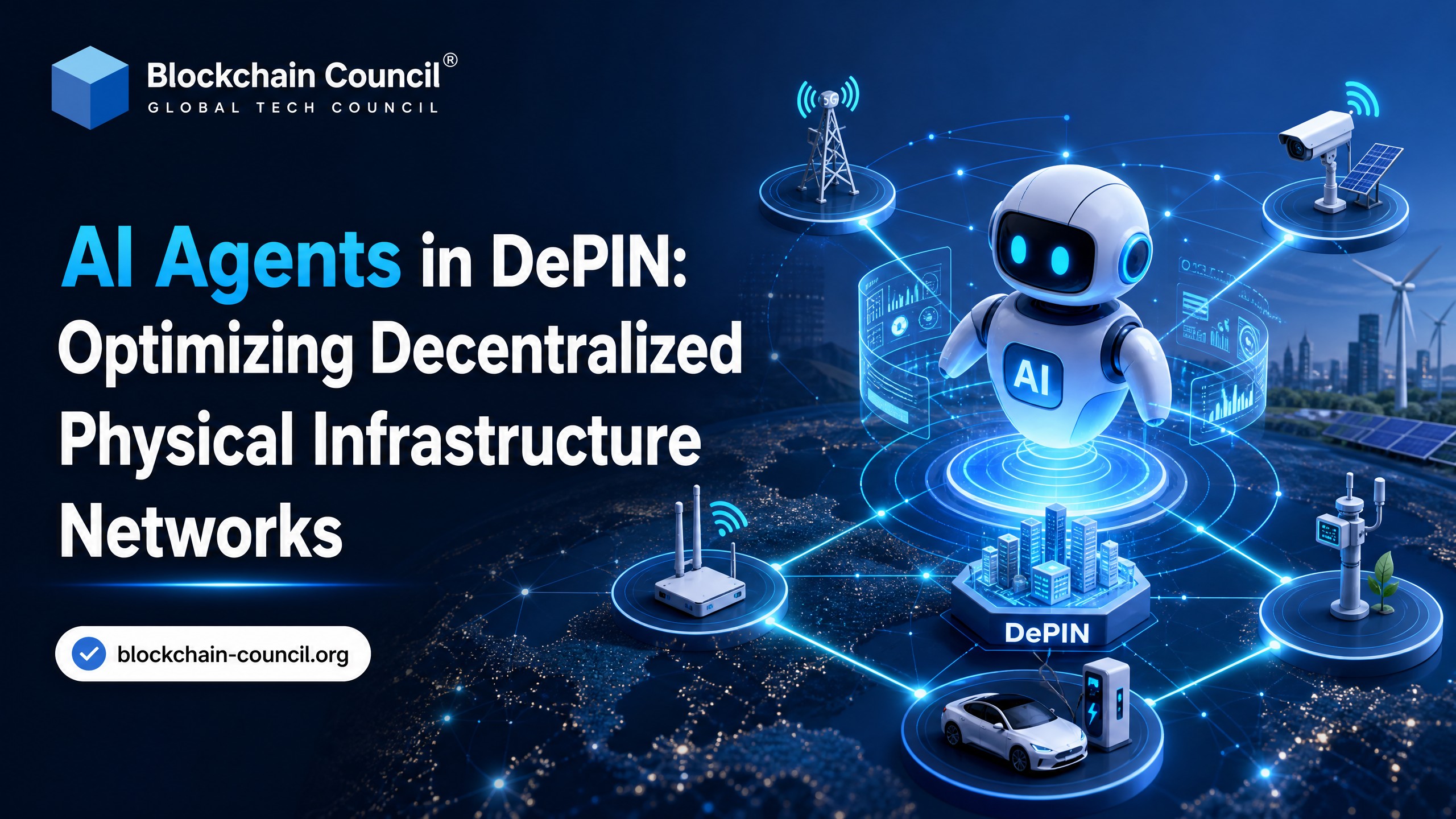
Artificial Intelligence Agents at DePIN They move from theory to production. They help decentralized physical infrastructure networks allocate compute, route traffic, verify device health, price resources, and coordinate rewards across devices that may be owned by thousands of independent operators.
This is important because DePIN is not just another cryptocurrency category. It connects blockchains to physical assets: GPU clusters, wireless hotspots, storage nodes, sensors, vehicles, batteries, and power devices. Once infrastructure becomes open, distinct, and globally distributed, manual coordination quickly breaks down. You need automation. In many cases, you need agents.
What does DePIN mean in practice
DePINs, or Decentralized Physical Infrastructure Networks, use blockchain incentives to coordinate real-world infrastructure. Operators contribute equipment or services. The network verifies useful work. Smart contracts and token mechanisms distribute rewards.
Examples include:
- Decentralized GPU networks for AI training and inference
- Wireless networks that provide connectivity through community-managed hotspots
- Storage networks where independent nodes provide file availability
- Sensor networks that collect local data for mobility, weather, energy, or supply chain systems
- Energy coordination networks that include batteries, solar assets, or demand response devices
The hard part isn’t just proving the existence of the device. The trickier problem is ensuring that it does useful work at the right time, at the right price, and under the right service constraints.
This is the place for AI agents.
What AI agents do inside DePIN networks
An AI agent is software that monitors the environment, evaluates options, takes action, and learns or adapts based on feedback. In DePIN, this environment includes node telemetry, task queues, token prices, response time, uptime, quota levels, bandwidth, storage availability, and user demand.
A well-designed DePIN agent can:
- Match workloads to available GPUs, storage nodes, or edge devices
- Expect congestion or lack of resources
- Adjust prices based on demand and reliability
- Detect faulty or dishonest nodes
- Trigger cross-chain payments, staking changes, or penalties
- Route requests across regions to reduce latency
- Recommend changes to governance parameters for human review
To be frank, most DePIN systems cannot scale on fixed rules alone. A fixed bonus formula may work at launch, then fail when demand spikes in one area, equipment quality varies, or operators start gaming the incentive model.
Why AI agents are useful for decentralized GPU computation
GPU computation is one of the clearest use cases for DePIN’s AI agents. The demand for AI inference and training has made GPU access expensive and unequal. DePIN compute networks attempt to aggregate idle or underutilized GPUs from multiple providers, then sell the compute to users who need it.
This seems simple. not so.
The task scheduler should take into account GPU type, VRAM, CUDA support, driver versions, network bandwidth, location, historical runtime, current queue depth, and price. If you’ve ever deployed a PyTorch workload across mixed GPUs, you know that small failures hurt. A node may pass the basic availability check and still fail at runtime because the driver stack is faulty. One common failure looks like this: CUDA error: There is no kernel image available to execute on the device. This often appears when the compiled workload does not match the GPU architecture, for example, a binary designed for a single compute capability runs on a card that does not support it. The naive scheduler misses that. The agent should not be practical.
In the DePIN GPU market, agents can measure nodes, group compatible devices, predict task duration, and direct inference workloads to nodes that meet latency and reliability goals. The result is better utilization of operators and a reduced number of failed tasks for users.
Key areas of improvement for DePIN’s AI agents
1. Resource allocation and scheduling
AI agents can treat compute, bandwidth, storage, and power as constrained resources. They decide where the workload should run, when it should run, and what is the acceptable trade-off between price, speed, and reliability.
Classic optimization is still important here. Linear programming, integer programming, heuristic search, and reinforcement learning can all be useful, depending on the network. You don’t need a big language model for every decision. For many scheduling tasks, a smaller policy model plus clean telemetry outperforms a large agent with ambiguous instructions.
2. Dynamic pricing and incentive adjustment
DePIN networks are incentive-based. Pay too little and the operators will leave. Pay too much and the network will subsidize low-value activities. AI agents can monitor usage, demand, quality of service, and fraud signals, then recommend or implement price changes.
This is especially useful in computing and wireless networks where demand is uneven. For example, a dense urban area may need different rewards than a rural area. A high uptime GPU provider should not be priced at the same price as a node that drops tasks during peak hours.
3. Predictive maintenance
Physical infrastructure failure. Fans decompose. Battery life. Hot spots lose connectivity. Storage disks become full or show errors. AI agents can analyze logs, sensor readings, and performance metrics to predict potential failures before they impact users.
Good maintenance agents do three things:
- Report unusual device behavior early
- Redirect workloads away from risky nodes
- Trigger alerts, service tickets or incentive changes
For businesses, this is not a nice addition. If DePIN supports a real service, downtime becomes a business problem.
4. Data quality and fraud detection
Many DePIN systems rely on crowdsourced data. This creates a clear attack surface. The sensor can report false readings. The node can spoof the location. A storage provider can claim availability that it does not provide.
AI agents help by scoring reputations, detecting anomalies, comparing nearby data sources, and identifying patterns that appear artificial. Blockchain gives you the ability to audit. It doesn’t automatically give you the truth. Still needs validation.
5. Coordination between agents
DePIN is naturally multi-agent. Node operators want revenue. Users want low cost and high quality. Protocol rulers want growth without abuse. Regulators want safety and accountability. These goals can conflict.
Multi-agent systems can represent different stakeholders and negotiate under rules defined by the protocol. For example, one agent might bid on compute on behalf of a user, while another agent manages capacity for a GPU provider. Settlement can be done on-chain, while most analysis is done off-chain in terms of speed and cost.
Where AI agents now appear in DePIN
Decentralized AI computing
GPU networking uses proxy systems to scale nodes, assign jobs, manage rates, and optimize runtime. This is likely to remain one of DePIN’s fastest-moving sectors because the demand for AI is immediate and measurable.
Wireless networks and the Internet of Things
DePIN wireless projects generate connectivity and telemetry. AI agents can manage routing, congestion, bandwidth allocation, and device reputation. For smart city or industrial IoT systems, this local data can feed machine learning models more effectively than one central source.
Supply chain data networks
Supply chain systems leverage real-time data: temperature, location, inventory levels, delivery status, and demand signals. DePIN can stimulate data collection, while AI agents make operational decisions such as rerouting shipments or adjusting inventory levels.
Energy coordination
Distributed energy assets need constant balancing. AI agents can help coordinate battery, solar production, load response, and local pricing. This is promising, but it also carries greater regulatory and safety requirements than a pure software network.
Secret artificial intelligence and data markets
Some architectures combine decentralized computing with confidential computing. In these systems, AI agents may select trusted execution environments, verify certificates, and schedule sensitive workloads. This is useful for healthcare, finance, and enterprise data, where privacy controls are non-negotiable.
Architecture: How these systems typically work
A practical AI-powered DePIN suite typically has five layers:
- Device layer: GPUs, sensors, routers, storage nodes, or power assets.
- Telemetry layer: Logs, benchmarks, uptime metrics, site directories, and performance data.
- Agent layer: Models and policies that make scheduling, pricing, validation, or maintenance decisions.
- Blockchain layer: Smart contracts for staking, rewards, discounts, identity and settlement.
- Oracle and integration layer: Bridges between off-chain data, external systems, and on-chain logic.
Don’t put every agent action directly on the chain. This is usually very slow and very expensive. The best approach is to account for decisions off-chain, provide signed proofs or results on-chain, and maintain auditability of high-value actions.
Risks and governance considerations
DePIN’s AI agents introduce new risks. Some are technical. Some are economical. Some of them are legal.
- Form error: Bad policy can lead to poor targeting of jobs or mispricing of incentives.
- Hostile behavior: Operators may learn how to manipulate recording systems.
- Regulatory exposure: Telecommunications, power, data protection and securities rules may apply depending on the network.
- Opacity: If an agent changes rewards or penalties, users need a clear explanation path.
- Central drift: If a single agent operator controls too many decisions, the network will be decentralized in name only.
My view: Agent autonomy should be introduced gradually. Start by developing a recommendation. Go to Limited Caps Execution. Use human governance to make high-impact changes to parameters. Complete autonomy sounds attractive, but critical infrastructure deserves guardrails.
Skills that professionals need to build in this field
If you want to work on AI agents at DePIN, focus on the intersection of three skill sets: blockchain systems, applied AI, and infrastructure operations.
Useful topics include:
- Smart contracts, staking, staking, and token incentive design
- Solidity 0.8.x and EVM and Gas Mechanics series such as EIP-1559
- Agent planning, reinforcement learning and optimization methods
- GPU processes, observability, and distributed task scheduling
- Data validation, anomaly detection, and reputation systems
- Security, compliance, and audit trails for automated decision making
For structured learning, consider Blockchain Council programs such as Certified Blockchain Expert™, Certified Blockchain Developer™, Certified Expert in Artificial Intelligence (AI)™and Certified Agent AI Expert™. These connect agent AI design to blockchain infrastructure, which is exactly the overlap that DePIN’s work requires.
Future Outlook for DePIN’s AI Agents
The next stage will be more specialized. General purpose agents will not be sufficient for DePIN workloads. Networks will need agents that are trained or adapted to hardware constraints, cryptoeconomic incentives, service level requirements, and regulatory boundaries.
Expect three developments:
- More off-chain information with on-chain accountability: Off-chain agents will decide, while contracts record obligations, payments, and penalties.
- Growing at the Edge and Federated Learning: DePIN nodes can train or update models close to where the data is produced.
- Corporate pilots: Buyers of energy, telecommunications, logistics and computing will experience DePIN where cost, transparency or flexibility justify the additional complexity.
DePIN’s AI agents will not replace good protocol design. They will uncover poor design faster. If incentives are flawed, agents may optimize the wrong thing too efficiently.
Your next step is practical: Define a single DePIN use case, define resource constraints, and then design an agent policy for scheduling, pricing, or validation. If you need a formal learning path, start with blockchain basics, then add agent AI and smart contract development before touching production infrastructure.