
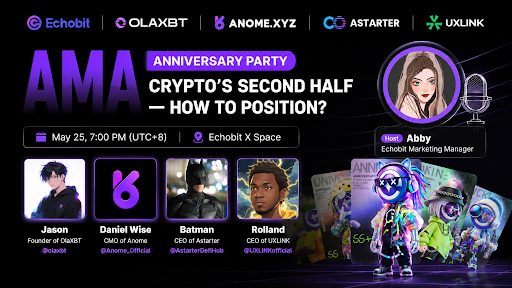
As the cryptocurrency market moves deeper into 2026, discussions around AI agents, prediction markets, Web3 games, DePIN infrastructure, and macroeconomic uncertainty will become increasingly important to both individual and institutional participants. during EcoBeatAt the recent anniversary AMA hosted by X Spaces, builders and ecosystem leaders from multiple sectors shared their insights on where the market may be headed in the second half of the year.
The AMA included representatives from OLAXBT, ANOME Protocol, ASTARTER, and UXLINK, covering topics including AI-powered infrastructure, the evolution of prediction markets, mainstream Web3 adoption, and long-term cryptocurrency investment strategies.
AI agents and DePIN continue to gain momentum
One of the main themes throughout the discussion was the rapid rise of AI agents and decentralized infrastructure.
ASTARTER representatives explained that AI agents are increasingly becoming active participants in blockchain ecosystems. Instead of acting as simple tools, these systems began executing trades, managing liquidity, interacting with smart contracts, and automating on-chain activities across decentralized environments.
Meanwhile, DePIN infrastructure is attracting increasing attention because scalable AI systems require decentralized computing power, storage, and data curation. The combination of AI, DePIN, and decentralized finance is gradually forming a new operational layer for the cryptocurrency economy.
Several speakers also highlighted the emergence of “DeFAI,” a sector that combines AI technologies and decentralized finance protocols to create smarter liquidity systems, automated trading frameworks, and autonomous financial products.
During the AMA, participants agreed that AI-driven infrastructure is likely to remain one of the most important sectors to watch in the next phase of cryptocurrency market development.
The BNB chain and AI games are attracting attention
Another major topic during the session was the future growth potential of the BNB ecosystem.
ANOME Protocol noted that while Ethereum and Solana continue to dominate public attention, the BNB Chain ecosystem has quietly maintained strong user activity and development momentum. According to the discussion, several projects continue to actively build within the BNB ecosystem, especially in areas related to gaming, AI integration, and scalable consumer applications.
Web3 games are also widely discussed. Speakers acknowledged that the sector has faced challenges over the past few years, but argued that AI integration may create entirely new gaming and earning models.
ANOME shared its vision for AI-powered gaming systems where users can deploy AI agents to engage in gameplay, optimize strategies, and automate certain winning mechanisms while maintaining user engagement and tactical oversight.
The discussion noted that future blockchain gaming ecosystems may increasingly combine NFTs, AI systems, DeFi infrastructure, and automated play into unified economic environments.
Prediction markets are expanding beyond speculation
Prediction markets were another major focus of the AMA conversation.
Speakers discussed how platforms centered around event-driven forecasting have evolved into one of the fastest growing areas of Web3 activity. From elections and sports to geopolitical developments and entertainment events, prediction markets are increasingly attracting liquidity and mainstream attention.
Participants explained that these markets combine financial incentives, social engagement, and artificial intelligence-based analysis in one ecosystem. At the same time, prediction markets are becoming more important as users increasingly rely on them to evaluate probabilities, monitor sentiment, and track potential outcomes in the real world.
However, many guests also cautioned that prediction-based sectors are still too reliant on narratives. Liquidity can shift quickly, and short-term speculation often results in significant volatility.
Despite these risks, many participants believe that prediction markets may continue to expand as Web3 products become more entertainment-oriented and easier for everyday users to understand.
Simplicity may define the next phase of Web3 adoption
A recurring theme during the AMA was the importance of simplifying Web3 user experiences.
Several speakers argued that mainstream users are less likely to adopt blockchain products if they have to understand complex technical concepts before participating. Alternatively, future crypto applications may succeed by making blockchain infrastructure nearly invisible to the end user.
Prediction market platforms have been cited as examples of this shift because many users interact with them without fully understanding the blockchain technology itself. The experience feels familiar, intuitive and accessible even to non-native audiences.
UXLINK discussed similar ideas while presenting its upcoming UX Agent initiative, which focuses on AI-powered tools designed for everyday users rather than high-tech crypto participants.
The discussion reflected a broader shift in the industry where user experience, simplicity and accessibility may become more important than technical development alone.
Individual investors are encouraged to remain disciplined
While many guests expressed optimism about cryptocurrency innovation in the long term, the AMA also emphasized the importance of risk management during the second half of 2026.
Macroeconomic uncertainty, geopolitical instability, inflation pressures, and persistent market volatility have been repeatedly cited as key factors affecting investor sentiment.
Many speakers encouraged retail sector participants to be cautious, manage expectations carefully and avoid chasing short-term hype cycles. Instead, they recommended focusing on project fundamentals, real benefit, long-term product development, and community strength.
Guests also highlighted the growing role of AI-powered research tools, noting that retail users now have much greater access to market analysis, project evaluation and investment research than in previous sessions.
At the same time, participants emphasized that technology alone cannot replace critical thinking, due diligence and understanding the long-term sustainability of projects.
The industry is moving towards utility and accessibility
Overall, the Echobit AMA reflected a broader shift occurring across the cryptocurrency industry.
While speculation and volatility remain a core part of the market, the conversation is increasingly focused on utility-driven infrastructure, AI-powered systems, streamlined user experiences, and long-term ecosystem development.
AI agents, DePIN, prediction markets, game automation, and real-world blockchain applications are gradually converging in a more mature and accessible Web3 environment.
As emphasized during the discussion, the second half of 2026 may ultimately reward projects that are able to balance innovation, usability and sustainable value creation rather than relying entirely on short-term narratives.
The AMA concluded with a shared view that the cryptocurrency market is entering a phase where adoption may increasingly depend on making blockchain technology simpler, more accessible and more relevant to everyday users around the world.
Echobit official links: twitter | Facebook | LinkedIn | YouTube