
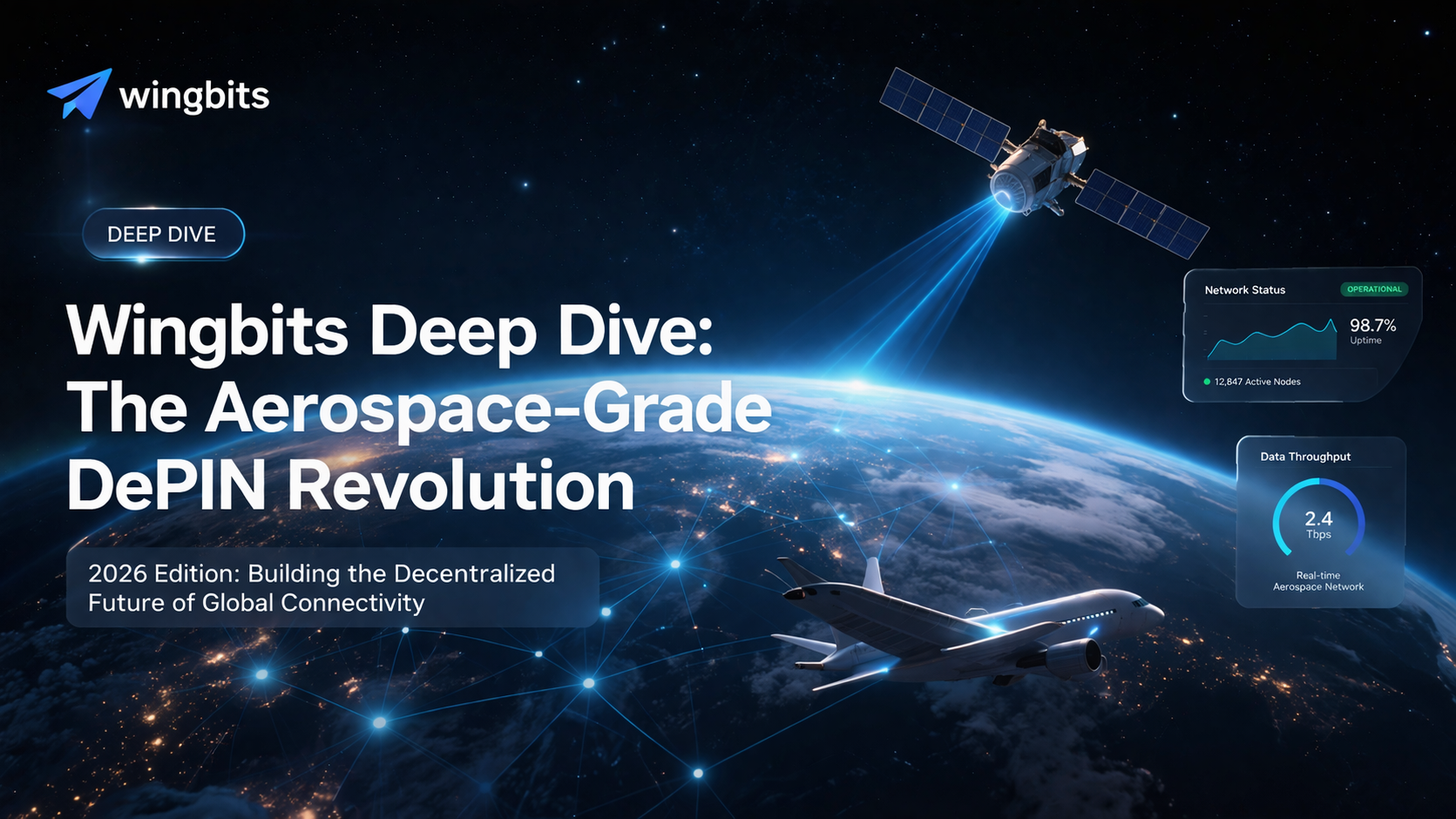
The rapid ascent of Decentralized Physical Infrastructure Networks (DePIN) has redefined how we build global utilities, and Wingbits stands at the vanguard of this movement. By incentivizing a worldwide community to track aircraft movements through blockchain-verified data, the project is successfully disrupting the multi-billion dollar aviation intelligence industry.
This comprehensive guide explores the Wingbits ecosystem, detailing its transition from a community-led tracking experiment to a sophisticated, space-integrated data powerhouse that powers modern aviation.
Key Takeaways
-
Wingbits is a DePIN project on Solana that decentralizes flight tracking using ADS-B technology.
-
The 2025 satellite launch has created the first “Space-to-Ground” integrated tracking network.
-
The $WINGS token economy incentivizes high-quality data through Proof-of-Location (PoL) verification.
-
Targeting a $22B market, the project services airlines, logistics, and Urban Air Mobility (UAM).
I. Project Positioning: The Only “Space-to-Ground” Integrated Infrastructure in the DePIN Sector
In the landscape of 2026, Wingbits has carved out a unique niche that distinguishes it from other DePIN peers like Helium or Hivemapper. While most projects focus on ground-based mapping or telecommunications, Wingbits targets the vertical dimension—the global airspace. It is currently the only decentralized network that combines a dense layer of community-hosted ground stations with a proprietary satellite constellation.
Redefining Aviation Data Ownership
Historically, aviation data was a closed-loop system dominated by a few centralized entities. These corporations relied on unpaid aviation enthusiasts to host receivers, selling the aggregated data for massive profits while offering contributors nothing but a “premium account” in return. Wingbits flips this model by:
-
Tokenizing Contribution: Users are stakeholders who earn $WINGS tokens for the data they provide.
-
Democratizing Access: By utilizing a self-serve API, the network lowers the barrier for developers to build aviation apps.
-
Global Scaling: Leveraging a decentralized workforce allows for rapid deployment in regions where centralized companies struggle to maintain infrastructure.
II. Technical Foundation: Deep Coupling of ADS-B Protocols with Solana’s Blockchain
At its core, Wingbits utilizes Automatic Dependent Surveillance-Broadcast (ADS-B) technology. This is the global standard for flight tracking, where aircraft broadcast their GPS position, altitude, and velocity every second.
Why Solana for Wingbits?
The choice of the Solana blockchain was a strategic necessity rather than a trend. Tracking thousands of flights globally generates a staggering volume of data packets. To handle the verification and micropayments associated with this data, the network required:
-
High Throughput: Capable of processing thousands of data-validation transactions per second.
-
Low Latency: Ensuring that rewards are calculated and distributed in near real-time.
-
Minimal Fees: Allowing for cost-effective reward distributions to thousands of small-scale node operators.
The Data Ingestion Pipeline
When a Wingbits node captures an ADS-B packet, it doesn’t just forward it blindly. The software performs “edge processing” to filter out noise, signs the data with a cryptographic key, and transmits it to the Solana-based verification layer. This ensures that the data used for the $WINGS reward engine is “clean” and tamper-proof from the moment it leaves the antenna.
III. Core Breakthrough: How the 2025 Satellite Launch Program Eliminated Global Monitoring Blind Spots
The most significant turning point for the project occurred on February 19, 2025, when Wingbits announced its move into space. Prior to this, decentralized tracking was limited by the “horizon problem”—ground-based antennas cannot see beyond the curvature of the earth or into the middle of the Atlantic Ocean.
Bridging the “Oceanic Gap”
By launching a constellation of low-earth orbit (LEO) satellites, Wingbits has achieved 100% global coverage. This “Space-to-Ground” architecture provides:
-
Continuous Tracking: Monitoring flights over oceans, deserts, and polar regions where no ground stations exist.
-
Redundancy: If a ground-based node goes offline due to a power outage, the satellite layer maintains the data stream.
-
Premium Data Tiers: The ability to provide “uninterrupted oceanic flight paths” allows the network to charge a premium to institutional clients.
Satellite-Ground Synchronization
The satellites act as “super-nodes.” They don’t replace the community nodes; rather, they synchronize with them. This hybrid approach allows for sub-meter accuracy by triangulating signals between the orbital receivers and the dense mesh of ground-based Wingbits miners.
IV. Node Ecosystem: The Evolution from Raspberry Pi DIY Kits to Industrial-Grade Purpose-Built Receivers
In the early days of 2023 and 2024, the network was primarily composed of “DIY” setups. Enthusiasts would purchase a Raspberry Pi, an RTL-SDR dongle, and a tuned 1090MHz antenna. While this was instrumental for early growth, 2026 has seen a shift toward “Plug-and-Play” hardware.
Current Hardware Tiers
To optimize the Wingbits network, the ecosystem now supports three distinct hardware categories:
-
The Lite Node: A low-cost, indoor USB-based receiver for casual users in high-density urban areas.
-
The Pro Miner: A weather-proof, outdoor unit with high-gain antennas and integrated GPS for precise timing.
-
The Enterprise Gateway: High-performance units designed for rooftops of tall buildings or industrial sites, capable of tracking 500+ aircraft simultaneously.
Optimization Factors for Miners
To maximize $WINGS earnings, operators must focus on:
-
Antenna Placement: A clear line of sight to the horizon is critical. Obstructions like trees or buildings significantly reduce data capture.
-
Uptime: The reward algorithm heavily penalizes intermittent connectivity.
-
Cable Quality: Using low-loss LMR-400 cables ensures that weak signals from distant aircraft aren’t lost before reaching the receiver.
V. Verification Mechanism: How Proof-of-Location (PoL) Eliminates Data Spoofing and Sybil Attacks
As the value of $WINGS tokens increased, so did the incentive for bad actors to “spoof” data. Proof-of-Location (PoL) is the specialized consensus mechanism Wingbits developed to maintain the integrity of its data feed.
The Mechanics of PoL
PoL relies on the laws of physics—specifically, the speed of light. When an aircraft broadcasts a signal, it reaches different Wingbits nodes at slightly different times.
-
Multilateration (MLAT): The network compares the timestamps of a single signal across multiple nodes. If the reported location of a node does not match the time-of-arrival of the signal, the data is rejected.
-
GPS Discipline: High-end nodes use GPS-disciplined oscillators to ensure their internal clocks are synchronized to the nanosecond.
-
Trust Scores: Each node maintains a reputation. Persistent accuracy increases the node’s “Trust Multiplier,” leading to higher rewards.
Defending Against Sybil Attacks
A Sybil attack involves one person running multiple virtual nodes to claim extra rewards. Because Wingbits requires physical signal reception validated by neighboring nodes, it is virtually impossible to “fake” a node’s presence. You cannot simulate the unique radio environment of a specific geographic location without actually being there.
VI. Economic Model: The $WINGS Token Flywheel—Supply-Side Incentives and Demand-Side Buybacks
The $WINGS token is the lifeblood of the ecosystem, designed to balance the interests of data contributors (supply) and data consumers (demand).
The Supply Side: Minting and Distribution
$WINGS tokens are minted and distributed daily to node operators. The distribution is not flat; it follows a “Quality over Quantity” philosophy:
-
Coverage Mining: Rewards for being the first to provide data in a “black spot” area.
-
Data Fidelity: Bonuses for nodes that capture high-frequency updates with zero packet loss.
-
Staking Tiers: Operators who stake $WINGS tokens can unlock higher reward multipliers for their nodes.
The Demand Side: The Burn-and-Mint Equilibrium
Airlines and developers don’t just use the data for free. They pay for API access.
-
Credits System: Users purchase Data Credits using $WINGS tokens.
-
Buyback and Burn: A portion of the revenue generated from data sales is used to buy back $WINGS from the open market and burn them, creating deflationary pressure.
-
Protocol Revenue: The remaining revenue is funneled into the Wingbits Treasury to fund further satellite launches and R&D.
VII. Commercial Horizon: A Decentralized Alternative to the $22B Aviation Big Data Market
The global aviation data market is projected to exceed $22 billion by the end of the decade. Wingbits is positioning itself as the low-cost, high-fidelity alternative to legacy providers.
Primary Customer Segments
-
Commercial Airlines: Using real-time data to optimize flight paths and reduce fuel consumption.
-
Logistics & Cargo: Integrating flight feeds into supply chain management software to predict “Last Mile” delivery times more accurately.
-
Financial Institutions: Using flight data to track corporate jet movements as a proxy for M&A activity and economic trends.
The API Advantage
Unlike legacy providers that require months of enterprise sales negotiations, the Wingbits self-serve API allows a startup to integrate global flight data in under five minutes. This “permissionless” access to data is driving a wave of innovation in the aviation app space.
VIII. Strategic Extension: Empowering Urban Air Mobility (UAM) and New Standards for Drone Regulation
As we look toward the late 2020s, the “Low Altitude Economy” is becoming a reality. Electric Vertical Takeoff and Landing (eVTOL) aircraft and delivery drones require a much denser tracking grid than traditional air traffic control provides.
Monitoring the “Last 1,000 Feet”
Standard radar is ineffective at low altitudes in urban environments. Wingbits, with its dense mesh of urban ground stations, provides the granular “micro-coverage” needed for:
-
Drone Deconfliction: Ensuring delivery drones don’t collide with each other or low-flying helicopters.
-
Noise Abatement: Helping cities monitor and enforce noise regulations for eVTOL corridors.
-
Search and Rescue: Providing the last known coordinates for small aircraft that might disappear from traditional radar.
IX. Development Roadmap: Ecosystem Explosion Following the 2026 Mainnet TGE
The 2026 Token Generation Event (TGE) marks the transition from a “beta” phase to a fully decentralized autonomous organization (DAO).
Post-TGE Milestones
-
Governance Integration: $WINGS holders will vote on protocol upgrades, reward structures, and satellite launch schedules.
-
Hardware Marketplace: The launch of an official marketplace where users can trade verified, “pre-aged” nodes with high trust scores.
-
Cross-DePIN Partnerships: Collaborations with weather-sensing DePINs to correlate flight delays with hyper-local weather data.
The Road to 100,000 Nodes
The project’s goal is to reach 100,000 active ground stations by 2027. This density would provide a level of resolution that no government-funded radar system could ever hope to match, effectively making Wingbits the “Google Maps of the Skies.”
X. Challenges and Limitations: The Tug-of-War Between Global Radio Compliance and Network Security
No ambitious project is without its hurdles. For Wingbits, the challenges are both regulatory and technical.
Navigating Global Regulations
Radio frequency (RF) regulations vary wildly by country. Some jurisdictions are wary of decentralized networks capturing “sensitive” aviation data.
-
Compliance by Design: The software is designed to filter out military or “blocked” tail numbers to stay within the legal frameworks of various regions.
-
Data Sovereignty: Ensuring that data stays compliant with local laws while being part of a global, borderless blockchain.
Countering Sophisticated Spoofing
As $WINGS becomes more valuable, the “arms race” between spoofers and PoL developers will intensify. The network must constantly evolve its AI-driven anomaly detection to identify and ban nodes that attempt to simulate signal propagation using advanced RF hardware.
XI. Conclusion
Wingbits represents the ultimate evolution of the DePIN narrative, proving that blockchain can orchestrate complex, aerospace-grade infrastructure without a central authority. By harmonizing community-led ground stations with a cutting-edge satellite constellation, the project has solved the coverage and accuracy issues that have plagued the aviation industry for decades. As the $WINGS token economy matures following the 2026 TGE, Wingbits is set to become the definitive source for global aviation intelligence, bridging the gap between Web3 innovation and physical-world utility.
FAQ
What is Wingbits and how does it work?
Wingbits is a decentralized flight-tracking network where users host ADS-B receivers to capture aircraft data. This data is verified on the Solana blockchain, and contributors are rewarded with $WINGS tokens for providing accurate, real-time aviation information.
How can I earn $WINGS tokens?
You can earn tokens by setting up a Wingbits-compatible ground station (node). Your earnings are based on the quality of your hardware, the number of unique aircraft you track, your uptime, and your geographic location’s importance to the network.
Is Wingbits better than FlightRadar24?
While FlightRadar24 is a centralized leader, Wingbits offers a decentralized alternative where the community owns the data. With its integrated satellite layer and token incentives, it provides higher accuracy in remote areas and rewards those who build the network.
What hardware do I need to join the Wingbits network?
Currently, most users use a Raspberry Pi or a similar single-board computer, an RTL-SDR dongle, and a 1090MHz antenna. In 2026, specialized “Plug-and-Play” miners are also available for easier setup and optimized performance.
Why did Wingbits launch a satellite?
The satellite launch in 2025 was designed to eliminate “blind spots” over oceans and remote regions. This created a “Space-to-Ground” integrated network, ensuring that Wingbits has 100% global flight tracking coverage regardless of ground station density.