
![“The ‘Machine Economy’ is just beginning… it will drive explosive growth” [Cointerview]](https://whatisdepin.io/wp-content/uploads/2026/04/The-‘Machine-Economy-is-just-beginning…-it-will-drive-explosive.webp)
- Beck said he was a Deepin-The first specialized class that aims to build Machine economy And an ecosystem where machines and people can directly own the value they create.
- Beck said he was aroused 35 million dollars From investors including Animoca Brands and HashKey Capital, and is expanding its ecosystem to include… 58 projects-Included DEBIN and RWA-to Token value (PEAQ)..
- Co-founder Dorlöchter said he will continue to grow in demand for the network and the token through Be realistic program, In cooperation with Korean companiesand Encouraging Korean investors to use DePIN.
Forecast trend report by period

Interview with Leonard Durlochter, co-founder of Peaq
Layer 1 blockchain dedicated to DePIN “peaq”
“DePIN is the engine of the ‘machine economy’ era”
“Focused on expanding the ecosystem to support the value of the token.”
“Korea is the ideal environment…in talks with major companies.”
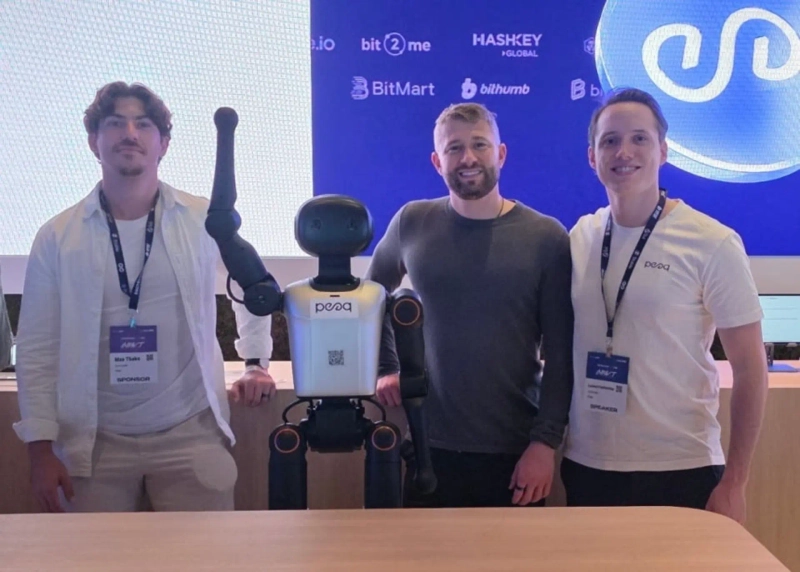
“At Web3, every piece of information users provide must be assigned a value, and rewards must be returned accordingly. By building the pinnacle of the ‘machine economy’, we will help machines and people interact freely to create new value – and empower them to directly own the results.”
Leonard Durlochter, co-founder of Peaq (PEAQ), said this in an interview with Bloomingbit on the 26th.
Peaq is a layer-one blockchain that specializes in decentralized physical infrastructure (DePIN) networks. DePIN refers to projects that apply blockchain-based economic systems to a wide range of devices, including energy and mobility. Users provide their data to the devices and receive compensation in the form of virtual assets (cryptocurrencies) or non-fungible tokens (NFTs).
Beck’s long-term ambition goes further. Rather than stopping at simply connecting devices and data, it aims to usher in an era of the “machine economy” where the activities of billions of machines – such as artificial intelligence, robots and drones – and their users can generate value.
“For the era of robotics and artificial intelligence to truly take hold, the machine economy must not become the exclusive domain of a handful of big tech companies,” Durlochter stressed, adding that “peak seeks an economy in which machines and people participate together as legitimate members of society – an economy that is owned by all.”
“The ‘machine economy’ has only just begun… and will grow exponentially.”
Peaq was founded in 2017. It initially looked into enterprise blockchain projects that combined the Internet of Things (IoT) with Web3 for enterprise clients, but after collaborating with global brands such as Audi and Gucci, it felt the limits of the existing infrastructure and continued to develop the first layer of its own blockchain.
Recognizing this vision, Peaq raised a total of $35 million in 2024 from investors including Animoca Brands, HashKey Capital, and Borderless Capital.
“Initially, investors often avoid us for talking about something too far in the future,” Durlochter said, adding: “To achieve the machine economy, we concluded that a public blockchain in which anyone can participate is necessary.”
He also said that the DePIN market has very high growth potential and will become a major driver of the machine economy. “The advantage of DePIN is that it can be applied across diverse markets such as energy, telecommunications, data storage and computing,” he said, adding that “some analyzes suggest that the DePIN market could grow into a multi-trillion-dollar industry.”
“Expanding the ecosystem to enhance the value of the token”
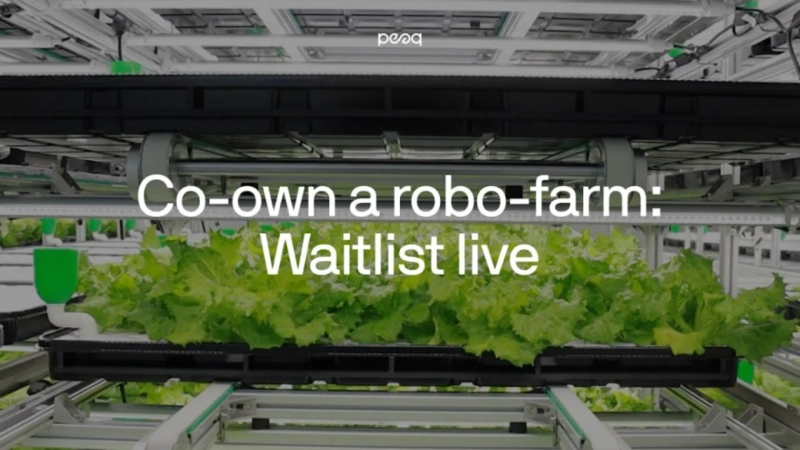
Peaq’s next goal is to lay the foundation for the machine economy by expanding its ecosystem. The crux of the matter is to enhance the value of the PEAQ token through this expansion. Currently, 58 projects – including DePIN and Real World Asset (RWA) tokenization – are participating in the Peak ecosystem. Most recently, it unveiled the world’s first “token robotic farm.” Robofarm is a model that automates farming using AI and robotics, and shares profits with investors in the form of NFTs.
“The peak token value ultimately follows the demand for projects within the ecosystem,” Durlochter said, adding: “We will focus on increasing demand for the token by expanding the number of projects that investors can find compelling.”
Peaq also runs a program called “Get Real.” Get Real is a program where users can complete tasks through DePIN apps and get rewards. “Get Real is designed to actively encourage user engagement,” Dorlöchter said, adding: “We are preparing several promotions going forward to drive network growth.”
“Cooperation with Korean conglomerates was noted.”
Expressing his strong interest in the Korean market, Durlochter said: “Korea has a world-class digital infrastructure and a high penetration rate for the Internet of Things, making it an ideal environment for realizing the machine economy,” adding: “We are preparing a mobile application that Korean users will be familiar with.”
He also hinted at the possibility of cooperation with Korean companies. “The energy and robotics sectors in Korea are developing rapidly,” he said, adding, “We are already engaged in active communications with Korean conglomerates.” He added: “It would be appropriate to start in areas such as energy grids, robot cafes, and smart farms.”
He also encouraged Korean investors to use DePIN. “Many users provide data but are not compensated fairly,” he said, adding: “I hope they get tangible rewards by using Peaq DePIN.”